
Sarawak’s economic transformation from a resource-based economy to a knowledge-driven, sustainable, and diversified powerhouse presents unprecedented opportunities.
The Premier has articulated a vision of Sarawak becoming “a creator and not merely a user of technology” if the state is to break out of the cocoon of being a low-based technology region.
He has emphasised that “the path to technological creation is not easy as it requires skilled manpower and high-cost research and development”.
Yet the potential of Sarawak’s economic transformation is inextricably linked to the potential of its people.
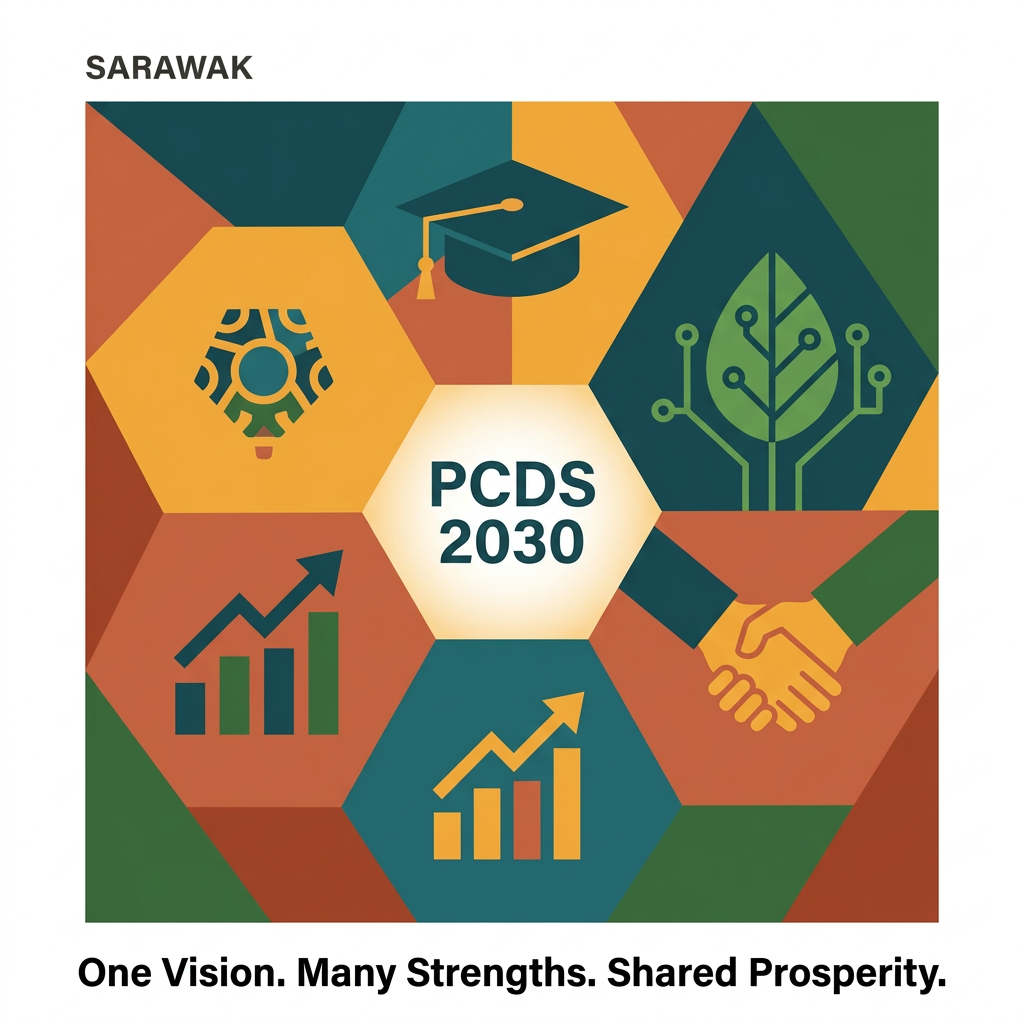
The new economy sectors identified under PCDS 2030 represent the frontier of Sarawak’s economic future.
Energy transition, hydrogen green energy, solar technology, carbon capture, utilisation and storage, and microalgae for sustainable aviation fuel are not merely buzzwords; they are the industries that will define global competitiveness.
The Premier has stressed that Sarawak must “leverage its natural capital and comparative advantages, combined with the latest technologies and skilled manpower, to drive more high-value downstream industries, expand green investments and create inclusive opportunities”.
The potential for Bumiputera participation in these sectors is immense but conditional.
It requires overcoming barriers that have historically constrained Bumiputera entrepreneurship.
The Premier has highlighted the strategic advantage of Bumiputera fluency in Mandarin, noting that this provides “a great advantage to Sarawak in international trade relations” and represents “a uniqueness that exists nowhere else”.
This is not merely a cultural observation; it is a strategic insight into how Sarawak’s multicultural heritage can be leveraged for economic advantage in the global marketplace.
The potential also lies in Sarawak’s unique natural assets.
Approximately 1.7 million hectares of Native Customary Rights land with extensive natural forest cover provide significant potential for carbon trading, contributing to environmental conservation while generating sustainable income for rural communities.
The Premier has articulated a clear principle: “Don’t Waste the Wastes , monetise the Wastes”.
For rural Bumiputera communities, this represents an opportunity to participate in the green economy while preserving their traditional livelihoods and cultural heritage.
The potential extends to human capital development.
The Premier has announced free higher education at Sarawak-owned universities beginning in 2026, stating that “this is the key for us to fight poverty and increase family income”.
This represents a transformative investment in the next generation of Bumiputera talent.
However, the potential will only be realised if the education and training provided is aligned with the needs of the new economy.
The Premier has emphasised that “human talent would be critical in helping entrepreneurs and businesses navigate an increasingly complex global economy shaped by rapid technological change”.
From an ESG perspective, the potential for Bumiputera participation in the new economy is fundamentally aligned with sustainability principles.
Alliance Bank’s ESG Report 2025 indicates a sharp rise in ESG awareness and adoption among Malaysian SMEs, with awareness climbing from 14 per cent in 2023 to 80 per cent in 2025, while adoption increased from 28 per cent to 60 per cent over the same period.
Nearly half of SMEs in Sarawak are self-funding their ESG initiatives, reflecting a strong commitment to sustainability.
This commitment, if properly supported, could position Bumiputera enterprises as leaders in the green economy rather than followers.
The Action Agenda for Transformative Change
The resolutions passed at the Bumiputera Economic Congress 2024 for the Sarawak region represent a pivotal moment.
They establish a clear framework for action: developing a comprehensive Bumiputera economic action plan, enhancing the capabilities of selected Bumiputera businesses and integrating them into new economic initiatives, and incorporating relevant inputs to ensure a comprehensive economic framework.
The Premier has emphasised that “the focus for 13MP is evident: better execution, better outcomes, and better lives for all Sarawakians”.
The action agenda is anchored in specific, measurable targets: three Bumiputera company listings on Bursa Malaysia, seven Bumiputera champions in each PCDS sector, and a 20 per cent conversion of micro-enterprises to private limited companies.
These targets represent a deliberate strategy to move Bumiputera enterprises from the margins to the mainstream of Sarawak’s economy.
The session engagement process conducted in Sarawak identified critical issues requiring action: access to quality education, rural development transformation, supply chain issues, financial and digital literacy, and economic and infrastructure development gaps.
The solutions proposed by session participants provide a practical roadmap.
In rural development transformation, a “Carve Out & Compete” policy and small business facilities were proposed.
In connectivity, accelerating internet access throughout Sarawak, particularly in rural areas, and expanding road networks were prioritised.
In education, strengthening the accreditation system, industry-based training, vendor development programmes with GLC and MNC involvement, TVET education, and STEM education were emphasised.
In financial and digital literacy, more financial literacy courses, a comprehensive entrepreneur data platform, tax incentives, venture capital platforms, and digital literacy modules were proposed.
The implementation framework recognises the importance of collaboration across four key sectors: federal and state agencies, Sarawak learning institutions, entrepreneur chambers, and Bumiputera MADANI.
Federal and state agencies provide policy formation, legal support, financial support, innovation support, and intervention.
Sarawak learning institutions provide research and development, incubators, and spin-offs.
Entrepreneur chambers provide entrepreneurship programmes, dialogue, social responsibility, and product and service development.
Bumiputera MADANI promotes responsible business practices and transparency, ensures business compliance, and engages in policy discussions.
This collaborative model is essential for creating a sustainable Bumiputera socio-economic ecosystem.
TERAJU has introduced several financing and facilitation programmes to help enterprises scale up, including the Sabah Sarawak Scale-Up Fund offering up to RM500,000 in financing with cash collateral support of up to 15 per cent, and the Islamic Working Capital Project Financing providing contract-based financing of up to RM1 million at a one per cent monthly profit rate.
Beyond financing, TERAJU connects enterprises with mentors, advisors, and corporate partners through facilitation programmes.
The strategic development communication imperative for this action agenda is paramount.
Messages must be aligned with the overarching development goals, ensuring that all communication activities directly support priority outcomes.
Stakeholder engagement must be genuinely inclusive, establishing two-way dialogue that leverages community insights and drives collective ownership.
Behaviour change must be catalysed through evidence-based, culturally resonant messaging that addresses barriers and promotes actionable practices.
Institutional capacity must be strengthened through systematic knowledge sharing and targeted training.
Trust must be built through consistent, ethical communication practices and responsive feedback mechanisms.
Continuous improvement must be enabled through data-driven evaluation that embeds monitoring and adaptive management into all strategies.
The expected outcomes are transformative: increased Bumiputera participation in entrepreneurship, upgrading of Bumiputera MSME status, increased employment opportunities in PCDS sectors, a skilled Bumiputera workforce, a competent workforce capable of competing globally, increased Bumiputera contribution to GDP, and improved policies and processes while avoiding overlap between agencies.
The Premier’s closing words at the Bumiputera Economic Congress 2024 capture the spirit of the action agenda: “Our collective commitment will drive positive change for Bumiputera in Sarawak”.
This is not a statement of hope but a declaration of intent.
The numbers are stark, the potential is immense, and the action agenda is comprehensive.
What remains is the execution.
The resilience of the Bumiputera community is evident in the thousands who have ventured into entrepreneurship despite systemic barriers.
The authenticity of their struggle is reflected in the micro-enterprises that sustain families and communities.
The kindness that must underpin policy responses requires recognising that these entrepreneurs are not statistics but individuals with aspirations, families, and communities depending on their success.
The advocacy must be relentless, demanding that the gap between aspiration and reality be closed through deliberate, evidence-based intervention.
The nurturing must be systematic, creating pathways for micro-enterprises to graduate to small, small to medium, and medium to large enterprises.
The path from resolution to reality requires not just policy but political will, not just funding but effective deployment, not just programmes but measurable outcomes.
Sarawak’s economic miracle must be a miracle for all Sarawakians, not just a privileged few.
The Premier’s vision of a RM282 billion economy is inspiring, but it will ring hollow if the 72.4 per cent who are Bumiputera are not full participants in its creation and beneficiaries of its rewards.
The gap between population share and economic participation is not just a statistic; it is a measure of unrealised potential, a testament to systemic barriers, and an indictment of policy approaches that have failed to translate demographic majority into economic participation.
The time for action is now.
References
Alliance Bank Malaysia Berhad. (2025). ESG report 2025. The Star. https://www.thestar.com.my/business/business-news/2025/12/15/steady-advancement-in-local-commitment-to-esg-standards
Department of Statistics Malaysia. (2025). Demographic statistics first quarter 2025. https://www.dosm.gov.my/portal-main/release-content/demographic-statistics-first-quarter-2025
Fulcrum. (2024). Envisioning a low-carbon future: Sarawak’s journey towards sustainable development. https://fulcrum.sg/envisioning-a-low-carbon-future-sarawaks-journey-towards-sustainable-development/
Ministry of International Trade and Industry Sarawak. (2024). SAF part of Sarawak govt’s vision for a green economy. https://mot.sarawak.gov.my/web/subpage/news_view/642
Sarawak Premier’s Department. (2025). Sarawak drives Bumiputera economic participation through SBB2035 strategic targets. https://premierdept.sarawak.gov.my/web/subpage/news_view/19904
Sarawak Premier’s Department. (2025). Sarawak tables Bill to establish Sustainable Resources and Wastes Management Authority. https://meesty.sarawak.gov.my/web/subpage/news_view/67
Swinburne University of Technology Sarawak. (2026). Free education. https://www.swinburne.edu.my/free-education/
The Borneo Post. (2025, November 25). Sarawak passes Sustainable Resources and Wastes Management Bill 2025. https://www.theborneopost.com/2025/11/25/sarawak-passes-sustainable-resources-and-wastes-management-bill-2025/
The Borneo Post. (2026, February 15). Premier: Year of the Horse to see Sarawak make big strides guided by clear policies, strong cooperation. https://www.theborneopost.com/2026/02/15/premier-year-of-the-horse-to-see-sarawak-make-big-strides-guided-by-clear-policies-strong-cooperation/
The Malaysia Reserve. (2024, February 14). Bumiputera Economic Congress to empower more native entrepreneurs and mastery of new tech. https://themalaysianreserve.com/2024/02/14/bumiputera-economic-congress-to-empower-more-native-entrepreneurs-and-mastery-of-new-tech/
Teraju. (2024). Financing. https://teraju.gov.my/financing/?lang=en
Utan Sarawak. (2025). Sarawak pacu usaha penyenaraian syarikat bumiputera melalui sasaran strategik SBB2035. https://utusansarawak.com.my/sarawak-pacu-usaha-penyenaraian-syarikat-bumiputera-melalui-sasaran-strategik-sbb2035/