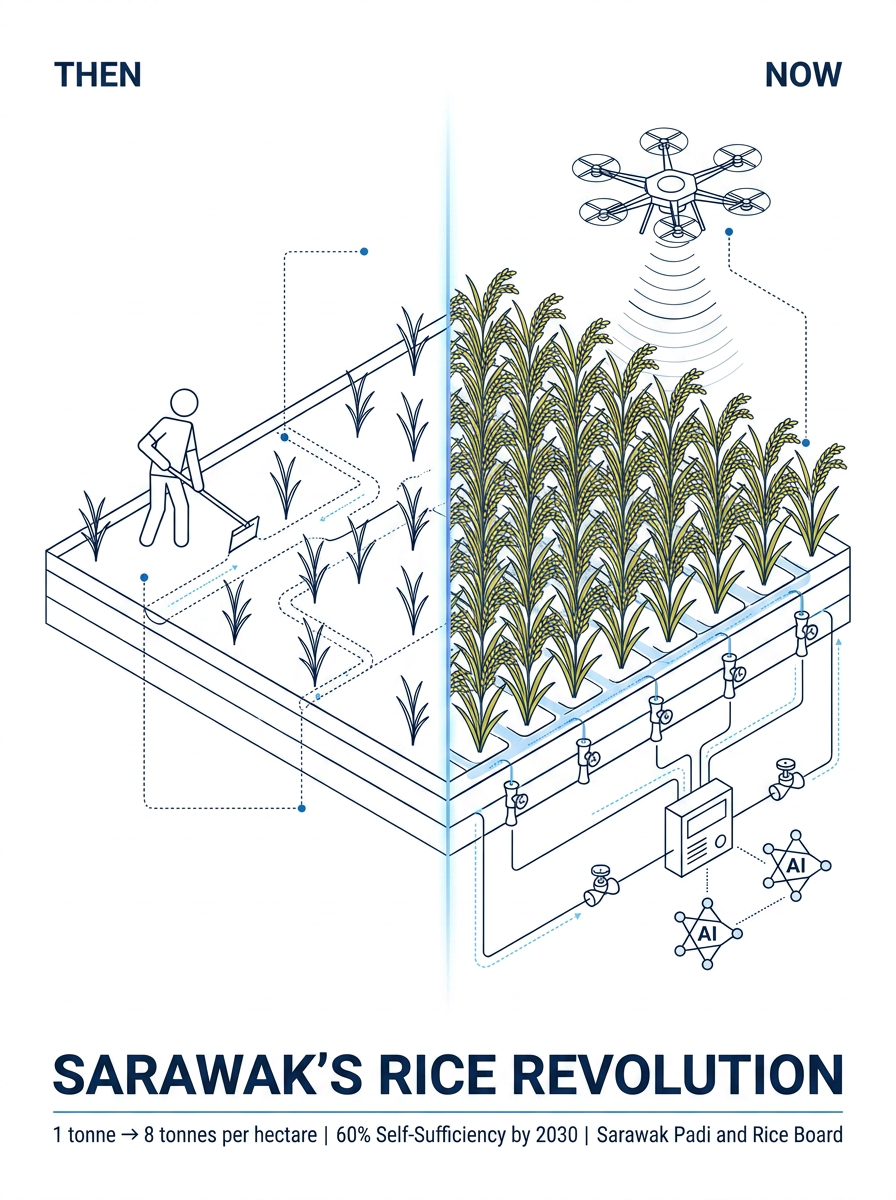

Imagine a future where Sarawak’s vast green landscape is dotted with thriving paddy fields, not just for nostalgic kampung scenes but as high-tech hubs of investment, smart production, and delicious premium rice products that travel from the heart of Borneo to dinner tables in Singapore, Hong Kong, and beyond.
That future is exactly what the newly passed Sarawak Padi and Rice Board Bill 2026 aims to build.
For young people thinking about careers, business, or even just the price of their favourite nasi lemak, this is a story of opportunity.
The numbers tell you why action is urgent.
Sarawak grows only about 21 percent of the rice it eats, importing the rest for RM460 million in just ten months of 2025.
Meanwhile, global rice production hit a record 556.4 million tonnes in the 2025–2026 season, yet fragile shipping routes, climate shocks, and sudden export bans by major producers can empty supermarket shelves overnight.
Malaysia as a whole imports up to 1.7 million metric tonnes of rice annually, and Sarawak’s reserve stock sits at just 33,000 metric tonnes.
The new Board is the state’s bold move to flip this script by attracting serious investment, modernising production, and creating high-value downstream products.
When it comes to investment, the numbers are eye-opening.
The Sarawak Government has already identified up to 15,000 hectares of new and upgraded granary land, with RM1 billion earmarked for paddy infrastructure.
In the 2026 State Budget, RM326 million was allocated to the agriculture sector alone.
YB Dr Simon Sinang (Tebedu) proposed using the Design, Build, Operate and Transfer model, inviting private companies to build modern irrigation and milling systems, operate them for a set period, and then hand them over.
YB Dato Sri Wong Soon Koh (Bawang Assan) insisted that all major investments, borrowings and asset disposals must go through the Minister or State Cabinet with transparent procurement, a call echoed by YB Royston Valentine (Tellian), who envisioned a Sarawak Rice Research Institute, a digital industry database, and a real-time food security dashboard.
The Board will be able to form companies, invest in research, and partner with the private sector, opening doors for young entrepreneurs to launch agritech startups, drone services, or organic fertiliser ventures.
On production, the ambition is massive but grounded in real plans.
To reach 60 percent rice self-sufficiency by 2030, Sarawak needs to produce between 240,000 and 500,000 metric tonnes of paddy annually.
That means deploying high-yield varieties like MR269 and MR315, which can yield 5.5 to 8 tonnes per hectare, a huge leap from the current average of just 1.3 tonnes.
YB Dato Sri Dr Stephen Rundi, the Minister who tabled the Bill, explained that state land will be gazetted exclusively for paddy, preventing the conversion to oil palm that has seen paddy area crash from 90,865 hectares in 2020 to just 45,269 hectares in 2024.
YB Datuk Mong Dagang (Bukit Begunan) proposed a paddy seed bank to preserve genetic diversity and ensure farmers get only certified, disease-resistant seeds.
YB John Ilus (Bukit Semuja) reminded the House that paddy farming is not just a job but central to Dayak culture and the Gawai festival, and the Board must ensure young natives are trained and included.
Meanwhile, YB Kennedy Chukpai Ugon (Murum) stressed that NCR landowners must be genuine partners, not displaced observers.
The most exciting part for future-focused youth is the downstream potential.
Sarawak already exports its aromatic Bario, Biris, and Bajong premium rice to Singapore, New Zealand and Hong Kong, a high-value niche far removed from bulk commodity markets.
YB Puan Violet Yong (Pending) argued that Sarawak should go all-in on this high-value, low-volume strategy, targeting gourmet markets and building subsidised logistics hubs for remote areas like Long Semadoh, where transport costs can exceed the price of fertiliser.
YB Datuk Ding Kuong Hing (Meradong) called for formal certification of Sarawak’s over 500 traditional rice varieties, creating Genetic Purity Zones that would turn “agricultural black gold” into internationally protected brands.
Beyond the grain itself, the Bill empowers the Board to commercialise research findings, meaning biomass from rice husks can become bio-fertilisers, packaging materials, or even energy, perfectly aligning with the green economy goals of the Post COVID-19 Development Strategy 2030.
YB Encik Johnichal Rayong (Engkilili) noted that the Board can establish companies to bring these innovations to market, and YB Dato Dennis Ngau (Telang Usan) suggested opening key positions to international experts to fast-track technology transfer.
This is not just legislation.
It is an open invitation for the next generation to build a smart, sovereign, and sustainable food system, where the rice on your plate fuels a new rural economy.
Key Voices from the Legislative Assembly Debate on Investment, Production, and Downstream Products
YB Dato Sri Dr Stephen Rundi anak Utom (Minister, Kemena) confirmed the Board will give first priority to developing paddy on gazetted state land and will drive private sector participation through public-private collaboration.
YB Dr Simon Sinang (Tebedu) proposed the Design, Build, Operate and Transfer mechanism to attract private investment in irrigation, water management, and post-harvest handling.
YB Dato Sri Wong Soon Koh (Bawang Assan) recommended that all major investments, asset disposals, and borrowings require prior Ministerial or Cabinet approval with transparent procurement and independent audits.
YB Royston bin Valentine (Tellian) advocated for a Sarawak Rice Research Institute, a Small Farmer Protection Scheme, crop insurance, a digital industry base system, and a real-time food security dashboard to guide investment decisions.
YB Datuk Mong anak Dagang (Bukit Begunan) urged the Board to create a paddy seeds bank and a seedling production facility to supply only certified, high-yield, disease-resistant seeds to local farmers.
YB Puan Violet Yong Wui Wui (Pending) called for a high-value, low-volume premium rice export strategy, subsidised rural logistics hubs, a state seed bank, a heritage rice registry, and the use of Sarawak’s biomass for organic and bio-fertilisers to reduce input costs.
YB Datuk Ding Kuong Hing (Meradong) stressed the need to formally characterise and certify over 500 local rice varieties, establish Genetic Purity Zones, and encourage agro-park development with private sector participation.
YB Encik Johnichal Rayong anak Ngipa (Engkilili) highlighted that the Board may establish companies and invest in ventures to commercialise research findings and develop downstream industries.
YB Encik Anyi anak Jana (Ngemah) noted the potential for traditional hill and wet paddy to be developed into high-quality specialty rice with good market value, following the success of premium Bario rice.
YB Dato Dennis Ngau (Telang Usan) recommended the Board conduct feasibility studies for large-scale paddy in the Baram region and consider hiring foreign professionals where local expertise is not yet available.
YB Encik Kennedy Chukpai Ugon (Murum) insisted that development must respect NCR land rights and ensure inclusive benefits, with strong governance and accountability to safeguard public investment.
This is not a nostalgic dream; it is a strategic launchpad.
Sarawak is transforming its paddy sector into a living laboratory for agritech, bio innovation, and premium branding.
With over 500 traditional rice varieties waiting to be genetically characterised, a clear mandate for research commercialisation, and a government that has already earmarked RM1 billion for infrastructure and RM326 million for agriculture, the pieces are set.
The challenge is now an invitation: design smarter irrigation systems, deploy drone-based crop monitoring, turn rice husk waste into bio-fertilisers or sustainable packaging, and build the digital dashboards that will track food security in real time.
For the bold, the returns are multi-layered.
You are not just entering a commodity market; you are entering a high-value niche where aromatic Bario rice already commands premium prices in Singapore and Hong Kong.
You are partnering with a government that welcomes private investment through models like Design, Build, Operate and Transfer, and you are working alongside communities who hold deep cultural knowledge and rightful land ownership.
This is a chance to build resilient supply chains, protect genetic heritage, and create rural prosperity, all while tapping into a region hungry for food sovereignty.
The blueprint is drawn. The funding is committed. The market is waiting.
Now it is your turn to step in, innovate, and harvest a future that is as sustainable as it is profitable.
References
Bernama. (2025, December 2). RM326 Mln For Sarawak Agri Sector Under 2026 State Budget. Bernama. https://www.bernama.com/en/business/news.php?id=2498008
Food and Agriculture Organization of the United Nations. (2025). Rice Market Monitor. FAO Knowledge Repository. https://openknowledge.fao.org/server/api/core/bitstreams/0640f1d6-f2a3-4282-87c7-e0be6a4df820/content
KRI Institute. (2022, December 2). The Paddy and Rice Industry of Sabah and Sarawak: Status and Potential. https://www.krinstitute.org/publications/the-paddy-and-rice-industry-of-sabah-and-sarawak-status-and-potential
Macaranga. (2023, December 7). Sowing Seeds of Resilience in Heirloom Rice. https://www.macaranga.org/sowing-seeds-of-resilience-in-heirloom-rice/
Sarawak Legislative Assembly (DUN). (2026, May 12). Penyata Rasmi Persidangan Dewan Undangan Negeri Sarawak. https://duns.sarawak.gov.my/web/attachment/show/?docid=MGdKZHJBdysrSCtTb0psQ0hiQ0srQT09OjpNYfHzWtwAIFs5LmPD6uLy
Sarawak Tribune. (2025, December 2). State Identifies 15,000 Hectares For Commercial Paddy Cultivation. https://www.sarawaktribune.com/state-identifies-15000-hectares-for-commercial-paddy-cultivation/
Sarawak Tribune. (2026, May 12). DUN Passes Sarawak Padi And Rice Board Bill 2026. https://www.sarawaktribune.com/dun-passes-sarawak-padi-and-rice-board-bill-2026/