
- Sarawak has strong low-cost renewable power, but progress differs sharply by segment and timeline.
- Solar with signed offtake is the clearest private investment entry today.
- Hydropower and transmission are state-led, long-term plays best accessed through contracts and financing.
- Green hydrogen has been downsized twice and remains highly speculative without firm buyers.
- Investors should verify accounts, licensing rules and every capacity figure before committing capital.
Sarawak’s Renewable Energy Bet: What Investors Should Know Before They Sign
Sarawak wants to be Southeast Asia’s next renewable energy hub, and the pitch has real substance behind it: a hydropower-anchored grid, the cheapest unsubsidised electricity in Malaysia, and a state utility that carries a AAA credit rating. But a close look at the numbers, drawn from official filings, ministerial statements, and independent press reporting through September 2026, shows a state whose ambitions are moving on several different clocks at once. Hydropower is decades old and delivering. Solar is scaling fast. Cross-border power exports are advancing steadily. Green hydrogen, by contrast, has been quietly scaled back. Any investor weighing exposure to Sarawak’s energy transition needs to separate what is operating today from what remains a plan on paper.
A Grid Already Ahead of Its Own Targets
Sarawak entered 2024 with 5,745 megawatts of installed capacity against a recorded peak demand of 4,575 megawatts, a reserve margin of roughly 26 percent (Bernama, 2024; MyEnergyStats, 2024). Renewables, mostly hydropower, made up 62 percent of that capacity mix in 2024, beating the state’s own 60 percent target under the Post COVID-19 Development Strategy 2030 ahead of schedule (Bernama, 2024). Hydropower alone contributes about 70 percent of actual generation, a figure the state’s Premier reaffirmed in October 2024, though the distinction between capacity share and generation share is often blurred in public commentary and should not be conflated in any investment memo.
The state is targeting 10 gigawatts of installed capacity by 2030 and 15 gigawatts by 2035, with renewables holding at least 60 percent of the mix throughout. A simple arithmetic check against the pipeline described below, roughly 5.9 gigawatts online today, plus 1.3 gigawatts from the Baleh hydro project, plus 1.5 gigawatts of planned solar, reaches only about 8.7 gigawatts. That leaves a gap of close to 1.3 gigawatts against the 2030 target that will need to come from additional hydro, storage, or other sources not currently committed. Domestic demand cannot absorb anywhere near this volume of new capacity on its own, which is why cross-border export links sit at the centre of Sarawak’s entire growth thesis rather than being a side project.
The other pillar of the pitch is cost. Sarawak Energy Berhad’s average tariff runs about 28 cent per kilowatt-hour across roughly 700,000 accounts, comfortably below Sabah’s 34.5 cent and Peninsular Malaysia’s 40 cent on a 2024 ministerial comparison (Bernama, n.d.). That gap is the main draw for energy-intensive industry, aluminium and ferroalloy smelters, silicon producers, and increasingly data centres and green-technology parks looking for cheap, low-carbon power. It also caps the upside for any independent power producer selling into the grid, since regulated tariffs leave little room for pricing power. A 25 percent discount on domestic electricity bills applied from April through December 2026, a populist measure investor should factor into near-term revenue assumptions rather than treat as permanent policy (SoyaCincau, 2026).
On credit quality, RAM Ratings affirmed Sarawak Energy’s RM30 billion sukuk programme at AAA with a stable outlook in November 2025, citing gearing of 1.05 times as of mid-2025 and funds-from-operations debt coverage of 0.21 times (RAM Ratings, 2025). RAM also flagged meaningful revenue concentration, with aluminium producer Press Metal a significant contributor to earnings, a customer concentration risk that runs through several segments of this analysis. Because Sarawak Energy is wholly state-owned, there is no direct equity entry point. Sukuk instruments and project-level financing structures are the accessible routes for outside capital.
Hydropower Carries the Grid, But the Timeline Has Slipped
The existing hydro fleet, Bakun at 2,520 megawatts, Murum at 944 megawatts, and Batang Ai at 94 megawatts, totals 3,558 megawatts and anchors roughly 58 percent of the state’s generation capacity from plants concentrated in Kapit Division. The next major addition, the 1,285-megawatt Baleh hydroelectric project, is a 188-metre concrete-faced rockfill dam being built along the Baleh River by China Gezhouba Group and Untang Jaya. Its completion, once pitched at 2026, has slipped to a target of December 2029, with impoundment scheduled to begin in 2027 and take about two years; the Premier has separately referenced commissioning by 2030 (Premier’s Department Sarawak, 2025). Once operational, Baleh is expected to generate around 8,286 gigawatt-hours a year with 941 megawatts of firm capacity, lifting large hydro to 4,843 megawatts.
For investors, the honest reading of hydropower is that it is not really an entry point at all. Sarawak Energy builds, owns, and operates these assets outright, so private participation is confined to engineering, procurement and construction contracts, equipment supply, and operations and maintenance work. Baleh’s three-to-four-year slippage from its original schedule is a useful data point on how much patience state-led megaprojects in Sarawak actually require, and it should temper expectations for the pace of anything still on the drawing board.
Solar Is the Segment Doing the Most Right Now
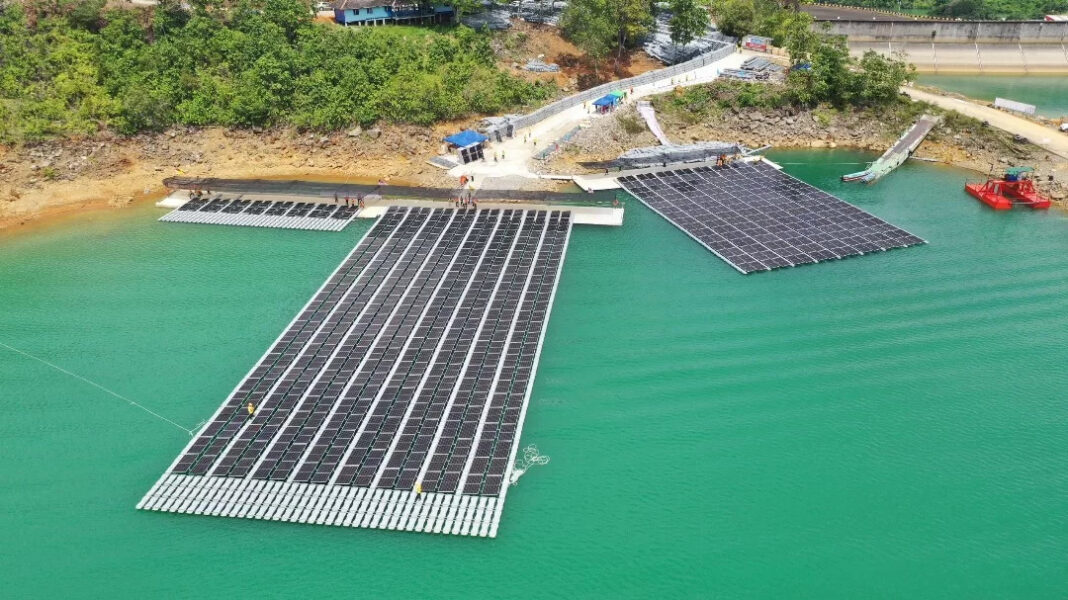
If hydropower is the backbone, solar and floating solar are where the state’s ambitions are advancing fastest and where private capital has the clearest way in. The Batang Ai floating solar farm, a 50-megawatt installation spanning 190 hectares and built through a joint venture of Sarawak Energy, China Power International Holdings, and Trina Solar, connected to the grid in December 2024 and is Sarawak’s first utility-scale solar project, offsetting an estimated 52 kilotonnes of emissions annually (Sarawak Energy, 2024). A further expansion of up to 120 to 170 megawatts has been floated by the Premier but remains pipeline rather than committed capacity, and an earlier feasibility study by Sarawak Energy cited a second-phase ceiling closer to 160 megawatts (Malay Mail, 2025).
Larger reservoirs are next in line for the same treatment. Bakun has a memorandum of understanding with China Three Gorges and Shanghai Electric for up to 1,000 megawatts of floating solar, with an initial 300-megawatt phase targeted for 2027, a timeline that looks ambitious given the project remains at study stage (Sarawak Energy, 2025; The Exchange Asia, 2025). Murum is the subject of a separate joint feasibility study involving Masdar, Gentari, and Sarawak Energy, also scoped at up to 1,000 megawatts (Masdar, 2025).
The most commercially advanced solar project outside the reservoirs is Kota Petra Green Technology Park, a 100-megawatt agrivoltaic development by listed contractor Zecon Berhad, which holds a 30-year power purchase agreement with Syarikat Sesco Berhad starting December 2027. A RM328 million engineering, procurement, construction and commissioning contract was awarded in July 2026, and a further 300 megawatts remains available under the developer’s licence for future phases (The Star, 2026). Because it already carries a signed offtake agreement and is in active construction, Kota Petra is the closest thing in this entire pipeline to a de-risked, revenue-visible investment.
The state’s official solar target, revised under the Sarawak Energy Transition Policy, is 1,500 megawatts by 2030, up sharply from earlier framing that suggested a ceiling closer to 1 gigawatt, and any brief still citing the lower figure is out of date (DayakDaily, 2025).
Storage and the Regional Grid Are Quietly Becoming the Real Infrastructure Story
Sarawak Energy commissioned Malaysia’s first utility-scale battery energy storage system at Sejingkat, a 60-megawatt, 22-container installation costing RM128 million, which will become increasingly important as intermittent solar capacity grows (SolarQuarter, 2025). Reporting has been inconsistent on whether the system’s energy rating is 60 or 82 megawatt-hours, and this figure should be confirmed directly with Sarawak Energy before it appears in any investment document.
The transmission side has moved just as fast. The 275-kilovolt Bunut, Medamit and Lawas lines, together with the Lawas substation, were commissioned in November 2025, physically opening the Sarawak-Sabah interconnection (Sarawak Energy, 2026; BIMP-EAGA, 2026). That link began commercial operation on 13 December 2025, with an initial export of 30 megawatts starting 4 December 2025 and capacity to scale toward 50 megawatts, including the potential for two-way flow (The Star, 2026). For a state whose entire growth strategy depends on selling power beyond its own borders, transmission and storage infrastructure like this is arguably a more investable, lower-drama story than the headline hydrogen and mega-hydro projects that dominate press coverage.
The Export Thesis Is the Real Hub Story, and It Is Advancing on Multiple Fronts
Sarawak already exports up to 230 megawatts of hydropower to West Kalimantan in Indonesia, an arrangement that predates most of the newer initiatives and remains the most established cross-border flow. The Sabah link, described above, is now commercially operating. A Brunei connection, targeted at a minimum of 30 megawatts, remains at negotiation and feasibility stage, with reporting split between an early 2027 start and a date closer to 2030 (Borneo Post, 2026).
The most ambitious and closely watched link is Singapore, where a proposed export of up to 1 gigawatt received conditional approval from Singapore’s Energy Market Authority on 17 October 2025, followed by clearance from Singapore’s National Security Council in December 2025 and its Maritime and Port Authority in February 2026 (Bernama, n.d.). Commercial and technical development work is now underway, though operations are not anticipated until the mid-2030s at the earliest. A further link to Peninsular Malaysia, also pitched at a minimum of 1 gigawatt, remains at the preliminary discussion stage and is reportedly attached to the 13th Malaysia Plan; capacity, timing and cost-sharing details should be treated as indicative until confirmed through primary government sources.
These are government-to-government infrastructure projects measured in years, not quarters, and none of them offer a direct equity stake to outside investors. The realistic access points are subsea cable supply, engineering and construction contracts, and project-level financing, all of which will see sustained demand as these links move from approval toward construction over the coming decade.
Green Hydrogen Has Cooled Considerably Since the Original Pitch
Green hydrogen is where the gap between the original brief and current reality is widest. Sarawak’s two flagship projects, H2ornbill and H2biscus, were both originally framed as major export ventures, with combined output once discussed at up to 90,000 tonnes a year by 2030. Both have since been scaled back. H2ornbill, developed by SEDC Energy with Japan’s ENEOS and Sumitomo, was originally sized at roughly 88,000 to 90,000 tonnes a year of methylcyclohexane for export to Japan; the Premier indicated in October 2025 that this could be cut to around 50,000 tonnes a year (Borneo Post, 2026). H2biscus, developed with Samsung Engineering, Posco, and Lotte Chemical, was originally scoped at about 150,000 tonnes a year of hydrogen destined for Korean ammonia production, and may now be redesigned toward low-carbon methanol instead. A final investment decision on H2biscus had been expected by June 2026, and this review found no public confirmation that one has been taken. A state deputy minister confirmed in June 2026 that both projects were being downscaled because of financial constraints (Borneo Post, 2026).
The Energy Industries Council reported in April 2026 that both projects had cut planned capacity in response to weak demand signals and uncertain offtake, warning that green hydrogen will struggle to compete against blue hydrogen and fossil-based alternatives without significant cost reductions (ICIS, 2025). Sarawak did complete a symbolic pilot export of green hydrogen to Singapore in September 2025, delivered in solid form using magnesium hydride, and state officials continue to describe a five-to-ten-year export strategy focused on Japan, South Korea, and Singapore, including exploration of bilateral frameworks such as Japan’s Asia Zero Emission Community initiative. For now, hydrogen remains a speculative allocation that should only attract capital alongside a committed offtake and staged, milestone-based deployment of funds.
Where Private Capital Actually Fits
Laid out by segment, the opportunity set looks like this. Solar and floating solar independent power producer projects, particularly those already carrying a signed power purchase agreement such as Kota Petra, offer the clearest visibility on returns and the shortest path to revenue. Engineering, procurement, construction, equipment, and operations and maintenance contracts span nearly every segment, from Baleh’s civil works to solar installation to battery integration to transmission build-out, and represent a steady, if lower-margin, way to participate across the entire pipeline. Fixed income investors can access Sarawak Energy’s state-backed credit quality through its AAA-rated sukuk programme. Industrial tenants and developers can capture the tariff advantage directly by locating in low-cost, green-power industrial zones such as Kota Petra and the broader Sarawak Corridor of Renewable Energy. Hydrogen and its derivatives should be approached only through staged capital commitments tied to confirmed offtake agreements, given how far both flagship projects have already been scaled back.
The Risks That Matter Most
Several risks cut across the entire pipeline rather than sitting neatly within one segment. Schedule slippage is now a demonstrated pattern rather than a hypothetical: Baleh has already slipped three to four years from its original target, and the Bakun floating solar timeline looks similarly optimistic given the project’s early stage. Customer concentration is real, with Sarawak Energy’s earnings leaning heavily on a small number of Sarawak Corridor of Renewable Energy customers, Press Metal chief among them, according to RAM’s own credit assessment. Offtake risk is most acute in hydrogen, where no firm buyers are locked in, while solar returns remain structurally capped by regulated tariffs regardless of demand. Sarawak Energy’s position as the sole buyer in the market means that power purchase agreement terms and broader state policy, not competitive market dynamics, will determine outcomes for any generator. Cross-border links require approval from multiple national governments, long subsea cable routes, and layered commercial agreements, any one of which can stall a project for years. The system’s roughly 70 percent reliance on hydropower also leaves it exposed to drought and reservoir constraints, an operational risk rather than a sourced statistic but one worth building into any stress test. Large dams carry lasting social costs as well; the Batang Ai dam alone displaced about 3,000 people from 26 longhouses, a reminder that resettlement and environmental impact remain live considerations for any new hydro development (Wikipedia, n.d.). Finally, Sarawak controls its own electricity regulation under an Electricity Ordinance amended in 2023, so licensing terms and foreign-ownership limits need to be confirmed on a project-by-project basis rather than assumed from federal Malaysian rules.
The Bottom Line
Sarawak’s fundamentals are genuinely strong: a large, mostly clean, low-cost power base, a state utility with an unimpeachable credit rating, and a set of export corridors that are moving, however slowly, toward commercial reality. But the pace of progress varies enormously by segment, and treating the whole pipeline as a single, uniform growth story would be a mistake. Solar with a signed offtake agreement is the closest thing to a de-risked entry today. Hydropower and cross-border transmission are long, state-controlled infrastructure plays best accessed through contracting rather than equity. Green hydrogen, despite the fanfare around its 2029 to 2030 timeline, has already been quietly downsized twice and should be treated as the most speculative allocation in the entire portfolio. Before committing capital to any of it, investors should insist on Sarawak Energy’s latest audited accounts, confirm licensing and ownership rules under the amended Electricity Ordinance, and independently reconfirm every capacity figure directly with Sarawak Energy or the state’s Ministry of Utility and Telecommunication.
This article is for general business and investment information only and does not constitute financial, legal, or investment advice. Readers should independently reconfirm all figures directly with Sarawak Energy Berhad or the relevant state ministry before making investment decisions.
References
Bernama. (2024, October). Sarawak exceeds renewable energy targets, 62% capacity mix. https://www.bernama.com/en/news.php?id=2354613
Bernama. (n.d.). Sarawak-Singapore electricity project and tariff comparison. https://bernama.com/en/news.php?id=2297100
BIMP-EAGA. (2026). Sarawak-Sabah power grid interconnection energized. https://bimp-eaga.asia/articles/sarawak-sabah-power-grid-interconnection-energized
Borneo Post. (2026, April 8). Sarawak hydrogen projects scaled down on weak signals. The Borneo Post. https://www.theborneopost.com/2026/04/08/sarawak-hydrogen-projects-scaled-down-on-weak-signals/
Borneo Post. (2026, May 18). Julaihi: Sarawak plans electricity exports to Brunei, Singapore, Peninsular Malaysia. The Borneo Post. https://www.theborneopost.com/2026/05/18/julaihi-sarawak-plans-electricity-exports-to-brunei-singapore-peninsular-malaysia/
Borneo Post. (2026, June 9). Sarawak recalibrates H2biscus and H2ornbill hydrogen projects amid financial constraints. The Borneo Post. https://www.theborneopost.com/2026/06/09/sarawak-recalibrates-h2biscus-and-h2ornbill-hydrogen-projects-amid-financial-constraints/
DayakDaily. (2025, June). Sarawak targets 1,500MW solar by 2030 to accelerate renewable transition. https://dayakdaily.com/sarawak-targets-1500mw-solar-energy-by-2030-to-accelerate-renewable-transition/
ICIS. (2025, October 28). Malaysia’s Sarawak state to scale down proposed low-carbon hydrogen on costs. https://www.icis.com/explore/resources/news/2025/10/28/11149587/malaysia-s-sarawak-state-to-scale-down-proposed-low-carbon-hydrogen-on-costs/
Malay Mail. (2025, October 6). Sarawak premier: Batang Ai sets out to become Malaysia’s largest solar power facility. https://www.malaymail.com/news/malaysia/2025/10/06/sarawak-premier-batang-ai-sets-out-to-become-malaysias-largest-solar-power-facility/193661
Masdar. (2025). Masdar, Sarawak Energy and Gentari to assess large-scale floating solar project in Malaysia. https://masdar.ae/en/news/newsroom/masdar—sarawak-energy-and-gentari-to-assess-large—scale-floating-solar-project-in-malaysia
MyEnergyStats. (2024). Sarawak system generation and demand, 2024 [Data set]. https://myenergystats.st.gov.my/dashboard
Premier’s Department Sarawak (UKAS). (2025, June). Baleh impoundment 2027, completion December 2029. https://premierdept.sarawak.gov.my/web/subpage/news_view/19825/UKAS
RAM Ratings. (2025, November). Sarawak Energy Berhad AAA affirmation. https://www.ram.com.my/pressrelease/?prviewid=7128
Sarawak Energy. (2024). Sarawak Energy’s first floating solar farm on track for commissioning by October 2024 [Media release]. https://www.sarawakenergy.com/media-info/media-releases/2024/sarawak-energys-first-floating-solar-farm-on-track-for-commissioning-by-october-2024
Sarawak Energy. (2025). Sarawak partners China’s leading energy developers to undertake floating solar project at Bakun Hydroelectric Plant [Media release]. https://www.sarawakenergy.com/media-info/media-releases/2025/sarawak-partners-chinas-leading-energy-developers-to-undertake-floating-solar-project-at-bakun-hydroelectric-plant
Sarawak Energy. (2026). Energisation of Sarawak-Sabah interconnection strengthens regional grid network [Media release]. https://www.sarawakenergy.com/media-info/media-releases/2026/energisation-of-sarawak-sabah-interconnection-strengthens-regional-grid-network-2
SolarQuarter. (2025, February 17). Sarawak Energy launches Malaysia’s first utility-scale battery energy storage system at Sejingkat Power Plant. https://solarquarter.com/2025/02/17/sarawak-energy-launches-malaysias-first-utility-scale-battery-energy-storage-system-at-sejingkat-power-plant/
SoyaCincau. (2026, April 17). Sarawak provides 25% discount on electricity bills from April to December 2026. https://soyacincau.com/2026/04/17/sarawak-provides-25-discount-on-electricity-bills-from-april-to-december-2026/
The Exchange Asia. (2025). Sarawak targets 1,000MW floating solar capacity with Bakun Dam project by 2027. https://theexchangeasia.com/sarawak-targets-1000mw-floating-solar-capacity-with-bakun-dam-project-by-2027/
The Star. (2026, January 26). Sarawak-Sabah interconnection paves way for regional RE. https://www.thestar.com.my/business/business-news/2026/01/26/sarawak-sabah-interconnection-paves-way-for-regional-re
The Star. (2026, July 23). Zecon unit secures RM328mil contract for 100MW Sarawak solar project. https://www.thestar.com.my/business/business-news/2026/07/23/zecon-unit-secures-rm328mil-contract-for-100mw-sarawak-solar-project
Wikipedia. (n.d.). Batang Ai Dam. Retrieved September 25, 2026, from https://en.wikipedia.org/wiki/Batang_Ai_Dam