
The Next Wave of Capital Has Found Its Delta
For decades, Southeast Asia’s growth story has been written in its cities. But global capital is changing its mind. As institutional portfolios saturate on urban real estate and industrial parks, the sharpest allocators are moving toward something scarcer and more durable: proven, policy-backed regional development, delivered ahead of the crowd.
In Sarawak, that opportunity has a name and a location. The Rajang Delta Development Agency (RADDA), established by the Sarawak Government to coordinate infrastructure and economic development across the Rajang Delta, is converting a historically hard-to-reach river landscape into a structured, state-de-risked corridor for agriculture, aquaculture, and green infrastructure investment.
This is a genuine first-mover window. It is backed by hard macroeconomic momentum and it sits squarely inside the Sarawak Post-Covid-19 Development Strategy 2030 (PCDS 2030) — the state’s flagship blueprint for high-income, sustainable growth.
“The Rajang Delta is not a speculative frontier. It is a state-sponsored, policy-backed, and increasingly data-validated economic corridor — and it is still early.”
The Macro Context: Riding PCDS 2030 and National Momentum
Capital moves where policy certainty and macro momentum meet. Both are present here.
Sarawak’s high-income ambition
PCDS 2030 commits Sarawak to nearly doubling its economy — from RM136 billion in 2019 to RM282 billion by 2030 — on the way to full high-income, developed-state status. That requires sustained six-to-eight percent annual growth, and the state government has already been recognised by the World Bank as a high-income region within Malaysia, a strong signal that the trajectory is real, not aspirational.
A national food security mandate
RM93.8 billion. That’s what Malaysia’s food import bill hit in 2024, according to the Department of Statistics Malaysia — up sharply from RM75.6 billion just two years earlier. Modernising domestic agriculture is now a national priority, and PCDS 2030 positions the Rajang Delta as a strategic answer to that dependency, not an incidental beneficiary of it.
Malaysia’s investment climate is firing on all cylinders
RM378.5 billion. Malaysia recorded its highest-ever approved investment total in 2024 — a 14.9% jump from the prior record set in 2023 — spanning services, manufacturing, and the primary sector. Sarawak is capturing a growing share of that momentum, particularly in green and digital economy projects, and the Rajang Delta is positioned to be one of its next beneficiaries.
A global demand curve that isn’t slowing down
60%. That’s how much the UN Food and Agriculture Organization projects global food production must rise by 2050 to feed a population approaching 10 billion. Regions with untapped arable land, fresh water, and logistics access — exactly what the Rajang Delta offers — are the ones positioned to capture that demand.
Why the Rajang Delta? An Asset the Market Hasn’t Priced In Yet
The Rajang River is Malaysia’s longest, running 565 kilometres from the Iran Mountains to the South China Sea. Its delta — spanning Sibu, Mukah, Dalat, Sarikei, and the Tanjung Manis peninsula — is not merely scenic. It is a working asset with distinct commercial advantages that few investors have discovered yet.
- The blue and green economy: The global aquaculture market is on track to surpass $300 billion by 2026, growing at more than 6% annually. The delta’s extensive riverine network is effectively ready-made infrastructure for modern, high-yield aquaculture.
- A natural, low-carbon logistics corridor: Inland waterway transport is 20% to 30% more fuel-efficient than moving goods by road. The Rajang River offers a direct route to the deep-water Tanjung Manis Port, bypassing congested land routes entirely.
- Land that hasn’t been fully unlocked: Sarawak holds more than 1.5 million hectares of agricultural land, and the delta’s fertile alluvial soils give it a distinct edge for premium, export-grade organic farming.
RADDA: A Catalyst That De-Risks the Market Before You Enter It
Entering any new regional market carries perceived risk for outside capital. RADDA exists specifically to remove it — using state-backed funding to prepare the ecosystem before private investors arrive, rather than asking them to build it themselves.
1. The infrastructure foundation is already being built
RADDA currently has 90 development projects underway across the delta, worth RM1.52 billion, on track for completion by 2028 — covering roads, water, electricity, and telecommunications across an area of more than 10,700 square kilometres. This is capital the private sector doesn’t have to spend.
- Electrification: Sarawak’s rural electricity coverage has climbed to roughly 98.6%, with the state pushing toward full, reliable rural coverage — critical infrastructure for agro-processing and tech-driven farming.
- Connectivity: Rural road paving and upgrading across the delta is a live, funded priority under RADDA’s infrastructure programme, steadily cutting the logistics costs that have historically limited private investment in the region.
- Water security: Clean water infrastructure rollout continues to expand rural access — a critical enabler for food & beverage and aquaculture operators evaluating the region.
2. A local supply chain that’s being professionalised for you
RADDA’s mandate covers a delta home to roughly 300,000 residents, including a dense base of smallholders and traditional fishers now being organised into commercially viable, investment-ready partners. With SMEs contributing an estimated 38% of Malaysia’s GDP, integrating with these upgraded local enterprises means faster community buy-in, cleaner supply chains, and built-in compliance with local content requirements.
3. A talent pipeline that’s actually being delivered
96%. That’s the current marketability rate for Sarawak’s TVET (Technical and Vocational Education and Training) graduates as of late 2024 — a remarkably strong figure. It sits inside a state-wide push to build 500,000 skilled workers by 2030 under PCDS 2030. For investors, that translates into a steady, localised pipeline of talent in agritech and modern aquaculture, without having to import or train a workforce from scratch.
High-Potential Sectors for B2B and Institutional Capital
The Rajang Delta offers several clear, data-backed entry points for capital looking to deploy at scale:
- Agri-Tech & Smart Farming — the global agri-tech market is projected to reach roughly $48 billion by 2030. IoT, drone technology, and precision agriculture solutions deployed here directly support PCDS 2030’s food-security mandate while capturing that global growth curve.
- Modern Aquaculture & Processing — there is a wide-open gap for closed-loop Recirculating Aquaculture Systems (RAS) and downstream processing at the Tanjung Manis Halal Hub, which the Sarawak Government is actively developing with dedicated port, airport, and logistics infrastructure to serve the global halal market, valued at over $2 trillion.
- Specialised Engineering & Green Infrastructure — the delta’s peatland and riverine topography calls for specialised civil and flood-mitigation engineering. With Sarawak already drawing over 70% of its electricity from renewable sources — predominantly hydropower — and pushing hard into solar, green-tech investors will find a genuinely receptive market for micro-grids and floating solar.
- Riverine Logistics & Cold Chain — a modern, eco-friendly river transport fleet paired with cold-chain storage stands to unlock much of the delta’s agricultural output, in a Southeast Asian cold-chain market currently growing at over 13% annually.
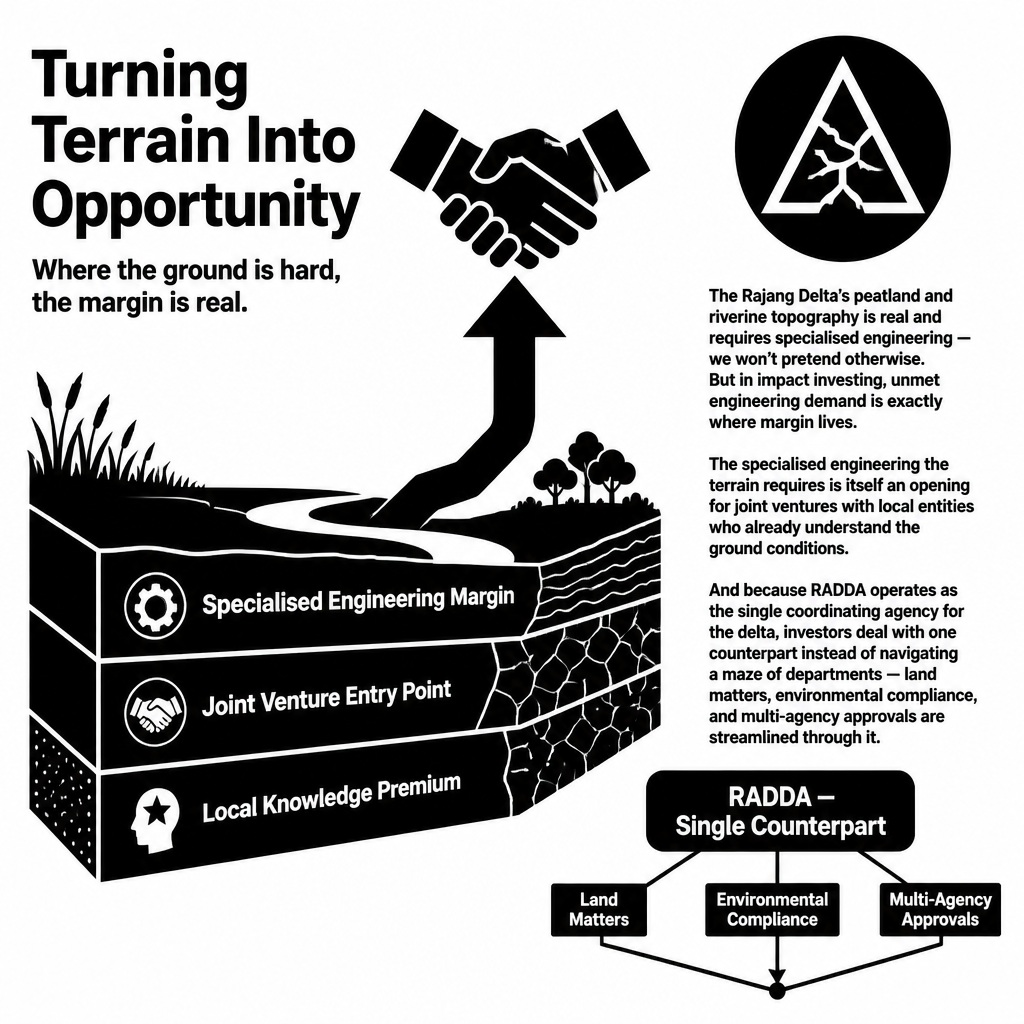
Turning Terrain Into Opportunity
The Rajang Delta’s peatland and riverine topography is real and requires specialised engineering — we won’t pretend otherwise. But in impact investing, unmet engineering demand is exactly where margin lives.
The specialised engineering the terrain requires is itself an opening for joint ventures with local entities who already understand the ground conditions. And because RADDA operates as the single coordinating agency for the delta, investors deal with one counterpart instead of navigating a maze of departments — land matters, environmental compliance, and multi-agency approvals are streamlined through it.
The ESG Dividend: Where Profit and Purpose Genuinely Align
$33.9 trillion. That’s where global ESG-linked assets are projected to reach by 2026, with the global impact investing market having already passed $1.16 trillion. Capital bound by ESG mandates isn’t just welcome in the Rajang Delta — it’s structurally suited to it.
The RADDA model is close to inherently ESG-aligned. When rural infrastructure is strengthened and local economies are lifted, the effects compound across all three pillars:
- Social — improved school access and localised job creation directly reduce rural poverty.
- Environmental — shifting from slash-and-burn or inefficient farming toward precision agri-tech cuts the region’s carbon footprint.
- Governance — RADDA provides a transparent, centralised framework for stakeholder engagement, rather than a fragmented one.
For corporate investors, that means a partnership in the Rajang Delta doesn’t just generate returns — it generates a verifiable, tellable impact story that strengthens ESG ratings and satisfies sustainability mandates with substance behind them.
Proof of Concept for a Much Bigger Map
The RADDA model isn’t a one-off. Sarawak has more than 3,000 rural settlements, many facing the same geographic and economic constraints the Rajang Delta faced before RADDA arrived.
The delta — home to roughly 300,000 people — is effectively the pilot. Its success will shape how similar regions across Sarawak, and the wider Borneo economy, get developed next. Investors who move early don’t just capture the returns available today; they position themselves as the trusted, proven partner for the next wave of regional expansion the state undertakes.
The Call to Action
The Rajang Delta is no longer just a point on a map. It is a state-sponsored, policy-backed, and increasingly data-validated economic corridor — underpinned by the RM282 billion ambition of PCDS 2030, supported by a funded, RM1.52 billion infrastructure programme already under construction, and coordinated end-to-end by RADDA.
Natural wealth. Government commitment. A market that hasn’t been priced in yet. That combination doesn’t stay open forever.
We invite domestic and international investors, agri-tech innovators, infrastructure developers, and impact funds to look past the traditional urban centres. Partner with RADDA and the Sarawak Government to unlock the Rajang Delta — where sustainable investment meets real socio-economic transformation, and genuinely exceptional financial returns.
For investment inquiries, partnership proposals, and detailed sector briefs regarding the Rajang Delta, contact the Rajang Delta Development Agency (RADDA) Investment Facilitation Office or the Sarawak Investment and Trade Centre.
References
DayakDaily. (2025, November 13). RM1.52 bln projects under Rajang Delta Development Agency on track for 2028 completion. https://dayakdaily.com/rm1-52-bln-projects-under-rajang-delta-development-agency-on-track-for-2028-completion/
EMIS Insights. (2024). Malaysia electric power sector report 2023–2024. https://www.scribd.com/document/755136032/EMIS-Insights-Malaysia-Electric-Power-Sector-Report-2023-2024
Encyclopædia Britannica. (n.d.). Rajang River. Retrieved July 18, 2026, from https://www.britannica.com/place/Rajang-River
Sarawak Energy. (n.d.). Power generation. Retrieved July 18, 2026, from https://www.sarawakenergy.com/what-we-do/power-generation
The Borneo Post. (2021, July 22). Sarawak launches its Post Covid-19 Development Strategy 2030. https://www.theborneopost.com/2021/07/22/sarawak-launches-its-post-covid-19-development-strategy-2030/
The Edge Malaysia. (n.d.). Sarawak aims to become an RE hub for the region. https://theedgemalaysia.com/node/787361
The Edge Malaysia. (2025, January). Malaysia secures record high RM378.5b approved investments in 2024. https://theedgemalaysia.com/node/745731
The Edge Malaysia. (2026, July 2). Cover story: How secure is Malaysia’s food supply? https://theedgemalaysia.com/node/808322
WeLoveSarawak. (2024, October). TVET in Sarawak: Shaping futures, powering growth in Borneo. https://welovesarawak.com/tvet-in-sarawak-shaping-futures-powering-growth-in-borneo/
World Wide Fund for Nature (WWF). (n.d.). The rivers and people of the HoB. Retrieved July 18, 2026, from https://wwf.panda.org/es/?209159/The-rivers-and-people-of-the-HoB