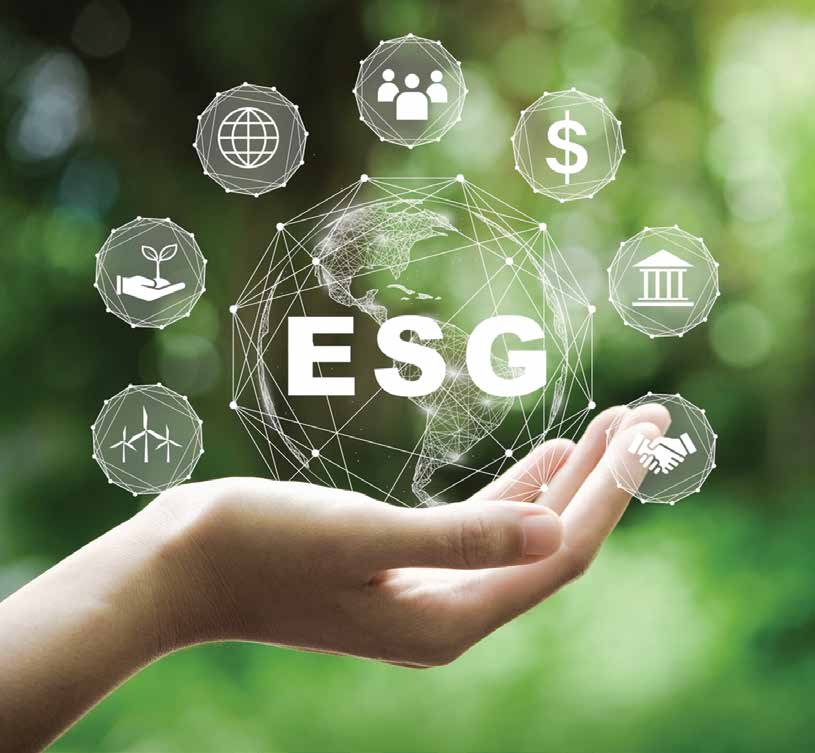

Unlike its predecessors, ESG is a more proactive approach for organisations to grow.
Taking account of a more comprehensive view that sustainability involves more than just the environment, the framework is becoming more important than ever in today’s increasingly volatile world.
ESG IS IMPORTANT FOR A VARIETY OF FACTORS
For investors, ESG considerations are vital in screening potential investments; globally, ESG-focused companies tend to perform better financially compared to their counterparts
For governments, emphasising ESG in businesses and even the public service strengthens their capability and drives efforts in tackling economic, environmental, and social issues affecting their nations.
In turn, society will be positively impacted from whatever fundamental change that takes place as a result of ESG initiatives by governments and the private sector; simultaneously continuing to push them to be more accountable and transparent in ensuring sustainability.

More importantly, organisations- be they multinational corporations or micro, small and medium-sized enterprises – that incorporate ESG in their strategies and operations will thrive in the long run, albeit costly and time-consuming to take on initially.
For the environment, ESG has multiple benefits. It brings awareness to the different climate issues that are occurring and encourages businesses to adopt practices and policies that are better for the environment.
For the social part of ESG, employees and shareholders are treated equally, and their health and safety are considered. It helps avoid bad business practices.
It also forces companies to innovate, which not only uncovers different opportunities but can open up more jobs. ESG is growing, and it is showing companies that they could either be a part of the solution or a part of the problem.
ESG and compliance are closely interconnected within an organization, and they both contribute to the trust and reputation of a business.
There are some who have voiced concerns that ESG adds more to the workload of compliance teams, who are already overburdened, and that there are more pressing issues to worry about, like cybersecurity and data privacy. Still, ESG compliance is becoming one of the top priorities for many organizations.
Although ESG policies are most often associated with private sector and nonprofit sector decisions related to financial instruments and investments, the public sector has both an historical and expanding role in promoting the value of ESG in its policies and decisions. Governments’ adoption and implementation of ESG is an important ethical value.
3 PRIMARY WAYS GOVERNMENTS PROMOTE ESG IN THEIR JURISDICTIONS
Adopting ESG goals within government operations and services
- Implementing ESG policies and regulations
- Incorporating ESG factors into decisions on government assets and liabilitie
In each area, governments seek to promote the public interest its policy decisions.
In many ways, the Sarawak government has been taking steps in making decisions that affirm the importance of environmental and social factors in advancing the common good of the nation.
Two sets of actions in which the Sarawak government is advancing ESG cover two primary areas:
- OPERATIONS AND SERVICES
- POLICY AND REGULATIONS
ENVIRONMENTAL SUSTAINIBILITY INITIATIVES OF SARAWAK
BETTER MANAGEMENT OF OIL AND GAS RESOURCES
Established Petroleum Sarawak Berhad (PETROS) on 24 July 2017 to develop the oil and gas industry in Sarawak with the objective of managing revenue from these resources for the implementation of ESG-relevant development projects.
PETROS’ projects aim to leverage revenues from Sarawak’s oil and gas resources to drive sustainable development across Sarawak.
Sarawak Petrochemical Hub in Bintulu
Expected to be catalyst for future growth of downstream petrochemical activities in Sarawak. Comprising projects focusing on methanol-based derivatives, as well as renewable energy. Green methanol is a low carbon fuel that can be made from either biomass gasification or renewable electricity and captured carbon dioxide (CO2).
GREEN AND BLUE ECONOMY
Sarawak Premier has maintained his unwavering commitment to safeguarding Sarawak’s natural environment and resources throughout his many years of service for Sarawak.
When he was the Minister for Industrial Development, he encouraged and pushed for eco-friendly businesses. When he was the Minister for Tourism, he started to promote sustainable practices in tourism.
And since he took over the leadership mantle for Sarawak in 2017, Sarawak Premier has launched ground-breaking green economy and blue economy plans and projects that marks him as a truly innovative and trailblazing leader.
Hydrogen-based GREEN ECONOMY
Sarawak aims to become a leader in hydrogen-based green economy in Malaysia capitalizing on Sarawak’s abundant water resources.
Sarawak Premier’s decision to tap hydrogen is highly beneficial for Sarawak’s economic growth because the projected reduction in renewable energy and electrolyser costs, as well as the need for deeper decarbonisation of all economic sectors, is driving the emergence of a global market for green hydrogen and its derivatives.
Sarawak has started several projects focused on reducing its reliance on fossil fuel and amount of carbon footprint through the use of clean hydroelectric power resources and turning hydrogen into a primary fuel for transportation and energy storage, aiming to begin large-scale commercial production and export of hydrogen by 2027.
Hydrogen can be produced from diverse, domestic resources.
Currently, most hydrogen is produced from fossil fuels, specifically natural gas.
Electricity – from the grid or from renewable sources such as wind, solar, geothermal, or biomass – is also currently used to produce hydrogen.
HYDROPOWER
Sarawak Premier’s farsighted vision for Sarawak’s future compelled him to make the bold decision of making Sarawak’s government buy over the rights to the Bakun Dam from the Federal government in 2018.
Such a bold and decisive move is founded on his convictions that:
“an economy which has plenty of energy is an economy that has the best potential for growth in the long run. Our challenge now is to harness that great potential for growth using our energy resources. To be able to harness the full potential of growth for Sarawak is to have greater autonomy over our own destiny. We must decide on our destiny here in Sarawak, not somebody else deciding for us.
BLUE ECONOMY
There are several definitions of the Blue Economy, with the World Bank stating it as “sustainable use of ocean resources for economic growth, improved livelihoods, and jobs while preserving the health of ocean ecosystem”, while the United Nations puts it as an economy that “comprises a range of economic sectors and related policies that together determine whether the use of ocean resources is sustainable.”
In Sarawak’s context, the Blue Economy encompasses all economic activities in ocean and coastal areas. Together with the Green Economy, the implementation of Blue Economy will help increase and sustain the State’s revenue.
ECO-FRIENDLY Transport System: Autonomous Rapid Transit (ART)
Expected to be the world’s first public transit system to use hydrogen fuel cell-powered trackless vehicles that will run on dedicated lanes. The ART is at the centre of the Kuching Urban Transportation System (KUTS) Project that will start with Phase 1, which covers a 70km route over three lines – Blue Line, Red Line and Green Line – in Greater Kuching.