
Executive Synopsis
- Green Digital Infrastructure: Sarawak’s massive surplus of renewable hydropower provides a unique, cost-effective, and sustainable advantage for developing energy-intensive green data centres and cloud infrastructure, attracting global tech investments.
- Comprehensive Digital Ecosystem: Driven by the Post-COVID Development Strategy (PCDS) 2030, the state is rapidly expanding 5G connectivity, digitalizing SMEs, and fostering a vibrant startup ecosystem through targeted government grants and institutional support.
- Lucrative Investment Incentives: Leveraging its autonomous state rights, Sarawak offers highly competitive, bespoke tax incentives, pioneer status, and streamlined regulatory frameworks specifically designed to maximize ROI for foreign and domestic digital economy investors.
Full Article:
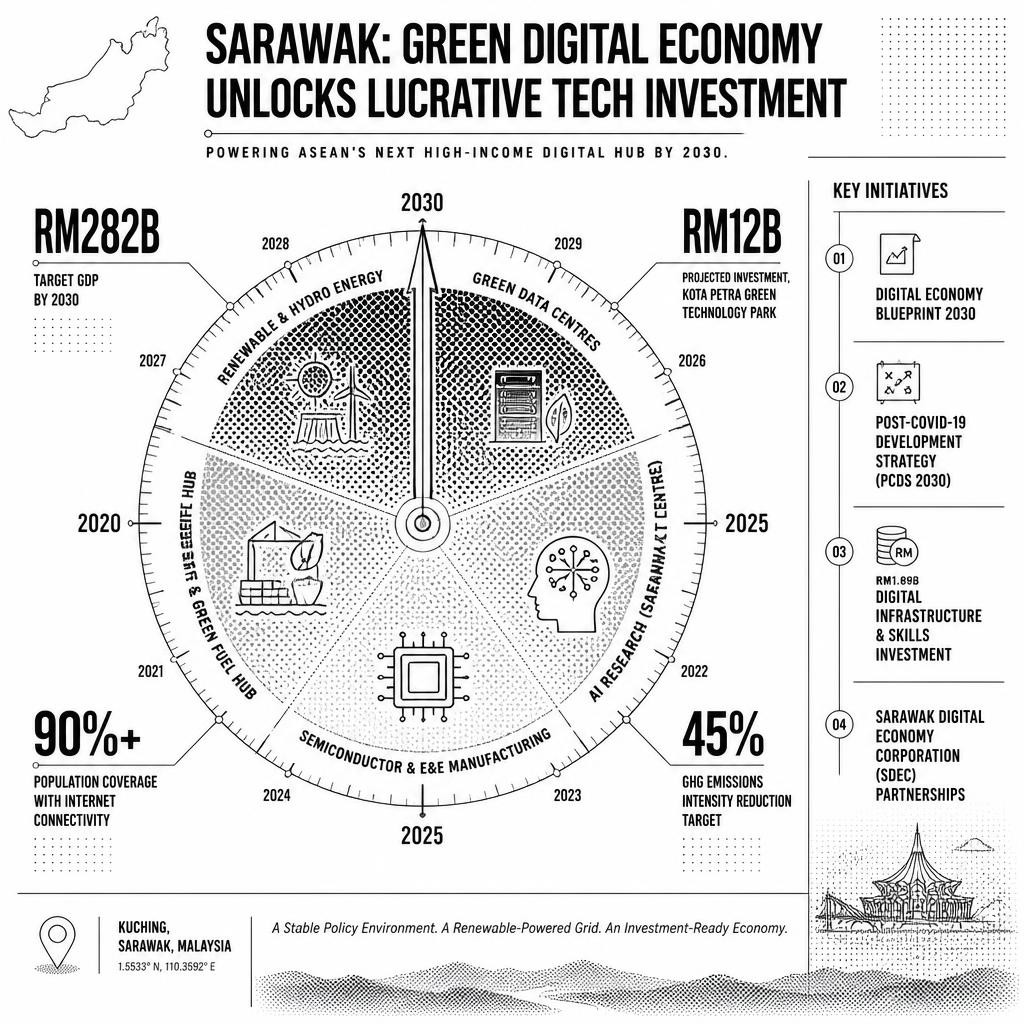
Sarawak Green Digital Economy Unlocks Lucrative Tech Investment
Sarawak, the largest state in Malaysia, is currently undergoing a profound and irreversible macro-economic paradigm shift. Historically defined by its abundant natural resources, crude oil, natural gas, timber, and palm oil, the state is actively transitioning from a resource-dependent extraction model to a high-income, sustainable, and digitally driven knowledge economy. This transformation is codified in the Sarawak Digital Economy Blueprint 2030, a comprehensive, state-backed roadmap designed to lift the digital sector’s contribution to the state’s Gross Domestic Product (GDP) to 20 percent by 2030, equivalent to approximately RM56.4 billion.
For global investors, sovereign wealth funds, and multinational technology conglomerates, Sarawak presents a rare convergence of favourable variables: abundant, low-cost renewable hydropower; proactive and autonomous state-level fiscal incentives; a rapidly expanding digital infrastructure pipeline; and an untapped, high-growth domestic market. The state’s massive surplus of renewable energy provides a unique, cost-effective, and sustainable advantage for developing energy-intensive green data centres, semiconductor manufacturing, and cloud infrastructure. Concurrently, aggressive government initiatives are digitalizing Small and Medium Enterprises (SMEs), fostering a vibrant startup ecosystem, and deploying advanced technologies like Artificial Intelligence (AI) and the Internet of Things (IoT) across agriculture, healthcare, and urban management.
Seamlessly integrating Sarawak’s strategic vision for a green digital transition with hard macroeconomic data, sector-specific investment opportunities, and rigorous financial modelling, the following analysis serves as an exhaustive guide for investors seeking to capitalize on green data centres, 5G infrastructure, semiconductor supply chains, agritech, and digital financial services. By leveraging its autonomous state rights under the Malaysia Agreement 1963 (MA63), Sarawak offers highly competitive, bespoke tax incentives, pioneer status, and streamlined regulatory frameworks specifically designed to maximize Return on Investment (ROI).
Through a detailed examination of the institutional framework, sector-specific deep dives, and a structured three-year ROI horizon, the analysis demonstrates that Sarawak is no longer merely a frontier market; it is the premier digital investment destination in Southeast Asia. Investors who align their capital with the state’s green digital economy will not only secure sustainable, high-yield financial returns but also play a pivotal role in shaping the future of the ASEAN digital landscape.
The Macro-Economic Paradigm Shift & Global Digital Capital Flows
The Historical Context and the Imperative for Change
For decades, Sarawak’s economic engine was driven by the extraction and export of commodities. While this resource-based model generated significant wealth and built the foundational infrastructure of the state, it also exposed the economy to the volatile fluctuations of global commodity prices. Recognizing the vulnerabilities of a resource-dependent economy and the impending risks of the middle-income trap, the state government initiated a profound macro-economic paradigm shift.
This shift is codified in the Post-COVID Development Strategy (PCDS) 2030 and operationalized through the Sarawak Digital Economy Blueprint 2030. The digital economy is not merely a supplementary sector in this strategy; it is the central pillar upon which the future prosperity of the state rests. The transition from a resource-based economy to a knowledge-and-digital-based economy represents one of the most significant economic transformations in Southeast Asia. The rationale is multifaceted: the digital economy offers higher value-addition, creates future-proof jobs, reduces the state’s carbon footprint in alignment with global ESG mandates, and democratizes economic opportunities for remote rural populations.
The Global Context: Digital Capital in Search of a Haven To understand the magnitude of the opportunity in Sarawak, one must first contextualize it within global capital flows. Digital investment is no longer a niche allocation; it is a dominant force in global foreign direct investment (FDI). According to UNCTAD reports, international investment in the digital economy has averaged around USD 122 billion annually in recent years.
The share of global FDI directed toward the digital sector rose from 5.5 percent between 2012 and 2014 to 8.3 percent between 2021 and 2023.
Furthermore, greenfield investment in digital sectors has nearly tripled since 2020 to approximately USD 360 billion, accounting for close to a third of all greenfield projects worldwide.
However, UNCTAD notes a critical geographic concentration: roughly 80 percent of digital greenfield projects flowing into developing economies have concentrated in just ten countries, most of them in Asia. This concentration is beginning to fracture as traditional hubs face capacity constraints, rising energy costs, and regulatory saturation. Global capital is now actively searching for jurisdictions with cheap power, political stability, and digital infrastructure headroom, exactly the combination Sarawak is positioning itself to offer.
Trade in digitally deliverable services, including software, business process outsourcing, cloud services, and professional services, accounted for 56 percent of global services exports, a figure consistently reported by UNCTAD for recent years, with the market continuing to grow at a robust pace toward multi-trillion-dollar valuations.
The artificial intelligence market alone is projected to approach USD 5 trillion (or approximately USD 4.8 trillion) by 2033.
These macroeconomic indicators describe a global capital pool that is highly mobile and aggressively seeking new frontiers.
The National and State-Level Performance Metrics At the national level, Malaysia’s digital economy has moved from aspiration to measured, undeniable performance. The Department of Statistics Malaysia (DOSM) reports that the information and communication technology (ICT) sector, combined with e-commerce, contributed 23.4 percent of the national economy in 2024, valued at RM451.3 billion.
Growth accelerated to 5.1 percent in 2024, up from 3.5 percent the previous year. The information and communication services subsector alone generated RM131.4 billion in revenue in 2024. The federal government’s target, reaffirmed by the Ministry of Digital, is for the digital economy to reach 25.5 percent of GDP by the end of 2025 and 30 percent by 2030.
Nationally, investment approvals back this trajectory. Under the Malaysia Digital status framework, approved digital investments hit RM163.6 billion in 2024, a 250 percent jump from 2023, creating more than 48,000 jobs.
The semiconductor push under the National Semiconductor Strategy has already attracted more than RM85 billion in approved investment as of late 2025.
However, Sarawak’s own historical investment record, while substantial in traditional sectors, revealed a glaring gap in digital FDI. Between 2021 and 2025, the state attracted RM116.8 billion in approved investments across manufacturing, services, and primary sectors.
In 2024, Malaysia Digital approvals into Sarawak stood at only RM280 million, dwarfed by the Klang Valley’s RM136 billion.
The Blueprint 2030 acknowledges this directly. This gap is not a weakness; it is the ultimate investment opportunity. Sarawak has already solved the harder problems of land acquisition, power generation, and political commitment. The state is now actively courting capital to fill a digital investment vacuum that its peers in Penang and Selangor no longer possess due to capacity and cost constraints. For the astute investor, Sarawak represents a high-alpha, blue-ocean market within a rapidly digitizing nation.
The Institutional, Policy, and Regulatory Architecture
To actualize the vision of the PCDS 2030 and the Blueprint 2030, the Sarawak government has established a robust institutional and policy framework specifically tailored to the digital economy. Unlike federal agencies that must balance the needs of the entire nation, Sarawak’s institutions are laser-focused on accelerating the state’s digital transformation, leveraging its autonomous rights under the Malaysia Agreement 1963 (MA63).
The Core Executing Agencies: SDEC and SMA The cornerstone of the institutional framework is the Sarawak Digital Economy Corporation (SDEC). SDEC acts as the catalyst, facilitator, and strategic partner for both local and foreign investors. They provide end-to-end support, ranging from site selection and regulatory navigation to talent matching and grant facilitation. SDEC’s proactive, investor-centric approach significantly reduces the friction typically associated with setting up digital operations in a new jurisdiction. Furthermore, SDEC has been allocated RM470 million in alternative funding to support digital infrastructure projects, broadening the pool of state-backed capital available to co-invest alongside private technology firms.
Complementing SDEC is the Sarawak Multimedia Authority (SMA). The SMA is specifically tasked with driving digital adoption at the grassroots level and ensuring that the digital divide is bridged. They are responsible for initiatives like the Digital Village program, which transforms rural communities into digitally literate, economically active nodes. For investors in agritech, rural e-commerce, and digital financial services, the SMA is a critical partner in market penetration and community engagement.
InvestSarawak: The One-Stop Investment Facilitator
A critical correction and update to the historical institutional landscape concerns the state’s investment promotion agency. InvestSarawak operates as the dedicated one-stop centre for digital and general investment facilitation. It ensures that licensing, approvals, and regulatory compliance are handled swiftly and efficiently, minimizing administrative delays. For foreign investors, InvestSarawak is the primary gateway to navigating the state’s bespoke incentive structures, land allocation, and utility connections.
Regulatory Agility and the MA63 Advantage
The policy framework is characterized by its agility and its foundation in state autonomy. The Ministry of Utility, Telecommunication and Digital Economy Sarawak provides high-level policy direction, ensuring that state policies are harmonized with federal initiatives while fiercely safeguarding Sarawak’s specific interests under MA63.
This autonomy allows Sarawak to offer distinct fiscal incentives that often complement and exceed federal incentives. Furthermore, the state government has demonstrated a willingness to rapidly update regulations to accommodate emerging technologies, such as drone delivery, autonomous vehicles, and blockchain applications. The government actively collaborates with the private sector to create regulatory sandboxes, allowing businesses to test and scale new technologies in a controlled, supportive environment. In many jurisdictions, digital innovators face years of regulatory limbo; in Sarawak, the regulatory environment is a competitive advantage.
Green Data Centres, Cloud Infrastructure, and the Hydropower Advantage
Perhaps the most lucrative and immediate investment opportunity in Sarawak’s digital economy lies in the development of green data centres and high-performance computing infrastructure. As global tech giants, hyperscalers, and enterprise companies migrate to the cloud, the demand for data centre capacity in Southeast Asia has skyrocketed. However, data centers are notoriously energy-intensive, and the traditional reliance on fossil fuels for power and cooling presents a significant ESG challenge and a massive operational expenditure (OPEX) burden.
The Unparalleled Hydropower Advantage
Sarawak possesses a distinct, almost unparalleled advantage in this sector: abundant, low-cost, renewable hydropower. Sarawak Energy estimates the state holds roughly 20,000 megawatts (MW) of hydropower potential across about 50 sites. To date, 3,452 MW has been harnessed through the Bakun, Murum, and Batang Ai dams. Crucially, the Baleh Dam, which has been under construction, is approaching completion and commissioning in 2026, adding a further 1,285 MW of clean, baseload capacity to the grid.
As of 2023, the state’s generation capacity of 5.75 gigawatts (GW) already exceeded demand of 4.27 GW. With supply capacity targeted to reach 9.5 GW by 2032, Sarawak has a massive, guaranteed surplus of green electricity [Update: more recent official statements (2024–2026) cite generation capacity of approximately 5.75–5.8 GW against rising demand of roughly 4.3–4.9 GW, and revised targets of 10 GW by 2030 and 15 GW by 2035, investors should use these newer figures for current planning purposes]. This energy is available at highly competitive industrial tariffs, drastically reducing the OPEX for data centre operators. Furthermore, the use of hydropower ensures that data centres in Sarawak can achieve exceptional Power Usage Effectiveness (PUE) ratings. In a world where multinational corporations are under immense pressure to decarbonize their supply chains (Scope 2 and Scope 3 emissions), hosting data in a facility powered by 100% renewable energy is a massive strategic advantage.
Live Projects and Infrastructure Pipelines
This surplus is already being converted into concrete, bankable projects:
- FutureData Park: A live example is the FutureData Park, which plans 500 MW of capacity across 135 acres. It features dark fibre connectivity through the Borneo and Singapore Interconnection Cable System and the SEA-H2X submarine cable, positioning it as an alternative regional hub with low-latency links into Singapore.
- Baram Green Data Centre Park: A more recent development is Founder Group Limited’s proposed RM1.16 billion (USD 276 million) 310 MWp solar-plus-storage project in Baram. This anchors a planned 200 MW Tier 4 green data centre park on 350 acres and is expected to generate more than RM1 billion in FDI on its own.
- The Singapore Exchange: At the bilateral level, Sarawak’s Premier has confirmed discussions to export up to 1 GW of renewable power to Singapore through an undersea cable expected by 2032. This is explicitly structured as an exchange: Singapore channels data centre investment into Sarawak in return for guaranteed green electricity.
Edge Computing and Submarine Connectivity
Beyond traditional hyperscale data centres, there is a growing opportunity in edge computing infrastructure. Given Sarawak’s vast geographical size, distributing edge data centres across key urban and industrial nodes (such as Kuching, Bintulu, and Miri) is essential for low-latency applications like autonomous logistics, smart manufacturing, and telemedicine.
Submarine cable connectivity is another critical area of investment. To fully realize its potential as a digital hub, Sarawak needs to reduce its reliance on terrestrial links to Peninsular Malaysia. Investors in submarine cable landing stations and data transit hubs will find strong government support. The strategic location of Sarawak on the island of Borneo makes it an ideal landing point for cables connecting the Asia-Pacific region, potentially transforming the state into a crucial internet exchange hub.
Data centre projects benefit from the most favourable tax treatment available. The federal Digital Ecosystem Acceleration Scheme (DESAC) grants Tier 1 digital infrastructure providers a choice between a 100 percent investment tax allowance (ITA) on qualifying capital expenditure, or a flat 10 percent income tax rate for an initial five years. Sarawak layers its own incentives on top, including a 100 percent ITA on qualifying capital expenditure offsetable against up to 100 percent of statutory income. For an investor entering during the current construction wave, the path from committed capital to contracted, recurring revenue inside a three-year horizon is highly realistic.
Semiconductor Manufacturing, Advanced Electronics, and the Hardware Supply Chain
While data centres represent the infrastructure layer, Sarawak’s semiconductor and advanced electronics cluster represents the hardware manufacturing layer. Unlike the data centre opportunity, which is largely a greenfield bet, the semiconductor sector in Sarawak is an active, massive expansion of existing, proven operations, which materially shortens the path to return.
The Anchor Investments and Reinvestment Wave
Sarawak is currently experiencing a historic wave of reinvestment from global semiconductor giants, leveraging the state’s stable power grid, strategic location, and existing skilled workforce:
- X-FAB: The Kuching-based wafer foundry has committed RM3 billion to expand its existing operations, focusing on specialty semiconductors crucial for automotive and industrial IoT applications.
- OCI Tokuyama Semiconductor Materials: Investing RM2 billion in a semiconductor-grade polysilicon facility in Bintulu, securing the upstream supply chain.
- Western Digital: Has committed RM1.8 billion to a glass substrate plant specifically built to support artificial intelligence hardware demand.
Together, these represent RM6.8 billion in reinvestment and an expected 1,300 high-skilled jobs. Because these are reinvestments by companies with established local supply chains and trained workforces, the effective time to incremental revenue is considerably shorter than a typical greenfield fabrication project.
Alignment with the National Semiconductor Strategy
This activity sits inside a much larger national push. The National Semiconductor Strategy has attracted more than RM85 billion in approved investment nationally, with a training pipeline aimed at 60,000 skilled workers.
This gives Sarawak-based operations access to a deepening regional talent pool.
Supply Chain and Industrial Park Opportunities
For investors, the practical entry points in the semiconductor sector are not limited to building fabs. High-yield opportunities exist in:
- Supply Chain Participation: Specialty gas and materials, precision components, and cleanroom logistics.
- Testing and Packaging Services: Feeding the anchor plants with localized QA/QC services.
- Industrial Park Development: Property and industrial park development around Samalaju and Kuching. The Sama Jaya Free Industrial Zone already provides duty exemptions for export-oriented electronics manufacturers, making it a highly attractive zone for ancillary suppliers.
Telecommunications, 5G, Non-Terrestrial Networks, and Connectivity
A robust digital economy is impossible without world-class telecommunications infrastructure. Sarawak’s unique topography, characterized by dense rainforests, rugged highlands, and extensive river systems, makes traditional telecommunications deployment challenging and capital-intensive. However, these very challenges create highly lucrative opportunities for specialized telecom investors and infrastructure providers.
The 5G Rollout and Fiber Backhaul
The rollout of 5G in Sarawak is a top priority. Unlike the 4G rollout, 5G requires a denser network of small cells and massive fibre backhaul. This presents a massive opportunity for investors in fibre-optic network deployment, tower companies (TowerCos), and neutral host providers. The government is actively encouraging Public-Private Partnerships (PPPs) to accelerate 5G coverage, particularly in industrial parks, smart city zones, and key economic corridors like the Sarawak Corridor of Renewable Energy (SCORE).
Non-Terrestrial Networks (NTN) and LEO Satellites
For investors in satellite communications and non-terrestrial networks, Sarawak is a prime market. The state’s vast rural and interior areas, which are economically unviable to reach with terrestrial fibre, are ideal for Low Earth Orbit (LEO) satellite internet providers. The government has shown a strong willingness to partner with satellite providers to deliver high-speed internet to rural schools, clinics, and digital villages, creating a guaranteed, subsidized revenue stream for investors. Utilizing alternative technologies, such as fixed wireless access (FWA) and LEO satellites, bypasses the need for extensive terrestrial fibre laying in remote areas, offering a faster ROI for rural connectivity projects.
IoT and LPWAN for Agriculture and Forestry
The deployment of Internet of Things (IoT) networks across the state’s vast agricultural and forestry estates presents a niche but highly profitable opportunity. Investors providing specialized, long-range, low-power wide-area network (LPWAN) solutions for precision agriculture, environmental monitoring, and asset tracking will find a ready market among Sarawak’s large plantation and logging conglomerates. These conglomerates are increasingly mandated by global ESG standards to adopt sustainable, tech-driven practices, making them highly motivated off-takers for IoT connectivity solutions.
Renewable Energy as the Ultimate Digital Enabler and Asset Class
Because every other digital opportunity in Sarawak is downstream of its power position, renewable energy deserves treatment as an investable category in its own right, rather than merely as an input cost. The digital economy and the green energy economy are inextricably linked; you cannot have the former without the latter in a sustainable, ESG-compliant model.
The Masdar MOU and International Capital Sarawak Energy’s memorandum of understanding with Abu Dhabi’s Masdar, under a broader agreement with the Malaysian Investment Development Authority (MIDA), targets up to 10 gigawatts (GW) of renewable energy projects across Malaysia with a potential investment of up to USD 8 billion.
www.mida.gov.my
Within this framework, an initial specific target involves developing 2 GW of renewable energy projects in Malaysia, with 1 GW of projects specifically earmarked for Sarawak (such as the proposed floating solar project at Murum Dam, which public Masdar/Sarawak Energy statements describe as a feasibility study for up to 1 GW).
This signals massive international confidence in Sarawak’s green energy regulatory framework and grid stability.
SCORE Repositioning and Green Hydrogen
The broader Sarawak Corridor of Renewable Energy (SCORE), originally conceived around heavy industry such as aluminium and ferroalloys anchored at Samalaju Industrial Park, is in the process of being repositioned in 2026 toward a green hydrogen economy, power export to the rest of ASEAN, and direct support for semiconductors and data centres. Investment vehicles here include direct participation in independent power producer (IPP) projects tied to data centre or industrial offtake, solar and battery storage developments, and transmission infrastructure linked to the Borneo grid. Because power purchase agreements (PPAs) in this space are typically long-dated and underwritten by anchor industrial tenants, cash flow visibility is exceptionally high.
E-Commerce, MSME Digitalisation, and the FinTech Revolution
While infrastructure and data centres represent the heavy capital expenditure side of the digital economy, the digitalization of Small and Medium Enterprises (SMEs) and the expansion of e-commerce represent the high-volume, high-frequency transactional opportunities. SMEs form the backbone of Sarawak’s economy, accounting for the vast majority of business establishments and employment.
The MSME Digitalisation Mandate
The Blueprint 2030 sets an explicit target for Sarawak of 80 percent of micro, small, and medium enterprises (MSMEs) digitalized by 2030, alongside a 40 percent increase in registered SMEs and a 30 percent uplift in labour productivity. Through SDEC, various digital adoption grants and matching funds are available to help SMEs transition online. For investors and tech companies providing Software as a Service (SaaS) solution, such as Point of Sale (POS) systems, inventory management, CRM, and digital accounting, this government-subsidized push creates a massive, captive market. MSME digitalisation projects require comparatively modest capital outlay and can be delivered and monetized within months, offering the shortest path to positive cash flow of any sector discussed.
E-Commerce and the Logistics Gap
E-commerce in Sarawak is evolving. While the penetration of major platforms is high, there is a distinct gap in localized, niche e-commerce, particularly in the agricultural and handicraft sectors. Investors who can build platforms that connect rural artisans, indigenous craftsmen, and local farmers directly to domestic and international consumers will generate significant returns and profound socio-economic impact. The integration of cold-chain logistics and specialized last-mile delivery solutions for e-commerce remains a critical pain point, representing a highly investable gap in the market.
FinTech: Sarawak Pay, SarawakPass, and Financial Inclusion
Financial Technology (FinTech) is rapidly expanding. It is crucial to distinguish between the state’s key digital financial instruments:
- Sarawak Pay: This is the state-backed e-wallet and digital payment gateway that has accelerated the shift towards a cashless society among merchants and consumers.
- SarawakPass: This is the unified digital identity platform (rebranded from Sarawak ID). It serves as the secure gateway through which citizens access AI-enhanced services, government portals, and commercial ecosystems.
Despite these advancements, a significant portion of the population, particularly in rural areas and among the B40 income group, remains underbanked. Investors in micro-lending, peer-to-peer (P2P) financing, digital insurance (insurtech), and alternative credit scoring models have a vast, untapped market. By leveraging alternative data, such as mobile phone usage, utility payments, and e-commerce transaction histories, FinTech companies can accurately assess the creditworthiness of previously unbanked individuals. The regulatory sandbox provided by the state allows FinTech innovators to test these models with reduced compliance burdens, accelerating time-to-market.
Agrotech, Digital Agriculture, and Rural Economic Transformation
Agriculture remains one of Sarawak’s largest employers, and the Blueprint treats its digitalisation as both an economic and social priority. The state plans to establish an agrotech park in every district, the creation of fifty new agribusiness start-ups, and private sector investment partnerships intended to lift labour productivity in the sector by 30 percent.
Precision Farming and IoT Integration
Precision farming, satellite and drone-based crop monitoring, and IoT-enabled irrigation and livestock management are specific technologies flagged as priorities. Unlike data centres or e-commerce, agrotech investments are constrained by biological growing cycles. Meaningful yield or efficiency data typically only becomes available after one to two full planting seasons.
Investment Horizons in Agrotech
Within a strict three-year horizon, the most realistic returns in this sector come from technology and service providers, precision agriculture equipment suppliers, agri-fintech, and traceability platforms, rather than from direct agricultural production. Investors providing end-to-end IoT solutions, from physical soil sensors to cloud-based analytics dashboards, will find strong government backing and potential off-take agreements. Furthermore, blockchain technology is being explored for supply chain transparency, particularly in the timber and agricultural sectors, to ensure compliance with international sustainability standards. Enterprise blockchain solutions that provide immutable tracking of goods from origin to export will find a receptive audience among Sarawak’s large commodity producers.
Artificial Intelligence, Government Technology, and Smart Cities
Beyond foundational infrastructure, Sarawak is actively positioning itself as a testbed and deployment ground for emerging technologies. The state government’s vision for “Smart Sarawak” relies heavily on the integration of AI, IoT, and Big Data analytics.
The Sarawak Artificial Intelligence Centre
Sarawak’s AI strategy is unusually concrete. The state cabinet approved the Sarawak Artificial Intelligence Centre to lead research, development, and commercialization of AI across healthcare, agriculture, education, and manufacturing. The 2026 state budget allocated RM33 million toward accelerating digital transformation and AI application, with RM5 million specifically earmarked for the Centre’s program.
For businesses, the near-term commercial opportunity clusters around systems integration, cybersecurity monitoring, data analytics, and applied AI solutions procured directly by state agencies. These categories monetize faster than infrastructure-heavy investments because they are largely service and software-based, requiring limited upfront capital expenditure. Malaysia’s parallel policy commitment under Budget 2026, which provides an additional 50 percent tax deduction for MSMEs on recognized AI and cybersecurity training expenses (accredited under frameworks like MyMahir) claimable into 2027, lowers the cost for local firms to build an AI-capable workforce, expanding the addressable market for AI vendors.
Smart Cities and Urban Tech
The development of Smart Cities, particularly in the Greater Kuching area and the rapidly industrializing region of Bintulu, presents massive opportunities. Solutions addressing traffic management, smart grid energy distribution, automated waste management, and intelligent water monitoring are in high demand. The government is actively seeking private sector partners to co-develop these projects through Build-Operate-Transfer (BOT) or PPP models. IoT sensor networks that monitor water levels and soil stability for disaster management (given the state’s susceptibility to seasonal flooding) are essential and backed by potential government off-take agreements.
The Startup Ecosystem, Human Capital, and the Talent Pipeline
A thriving digital economy requires a vibrant startup ecosystem and a deep pool of digital talent. Historically, Sarawak suffered from a “brain drain,” where top talent migrated to Kuala Lumpur or Singapore. The state government has invested heavily in reversing this trend.
Innovate Sarawak and the Digital Village
The cornerstone of this effort is the Innovate Sarawak initiative and the Digital Village incubator. The Blueprint targets 500 high-technology start-ups by 2030. As of recent data, dozens of high-tech start-ups and research projects are progressing through accelerator programs, backed by angel investment through MBAN Sarawak. For Venture Capital (VC) and Private Equity (PE) firms, Sarawak presents an emerging frontier with attractive seed and Series A valuations compared to saturated markets. Government co-investment through SDEC’s RM470 million funding allocation meaningfully de-risks early rounds for private investors.
Human Capital Development and Talent Attraction
support these startups, human capital development is paramount. The government has partnered with local universities, such as Universiti Malaysia Sarawak (UNIMAS) and Universiti Teknologi MARA (UiTM) Sarawak, to revamp curricula in coding, data analytics, cybersecurity, and AI.
Furthermore, the Sarawak government offers specific incentives to attract digital talent back to the state, including tax relief, housing subsidies, and fast-tracked residency. The state is also exploring an e-residency scheme designed to attract founders regardless of physical location. For foreign tech companies looking to set up regional hubs, this growing pool of bilingual, tech-savvy, and cost-competitive talent is a major draw. Investors in EdTech also find a fertile market, as the demand for continuous upskilling and micro-credentialing of the existing workforce is immense and heavily supported by state agencies.
Investment Mechanics, Fiscal Incentives, and the Three-Year ROI Horizon
Understanding the mechanics of investment and the specific incentives available is crucial for maximizing ROI. Sarawak’s autonomous right to offer distinct fiscal incentives is a massive competitive advantage.
The Incentive Architecture
- Pioneer Status: Exempts a company from paying state income tax on up to 70% of its statutory income for a period of up to 10 years for promoted digital activities.
- Investment Tax Allowances (ITA): Sarawak offers a 100% ITA on qualifying capital expenditures incurred within the first few years of operation, offsetable against up to 100% of statutory income (exceeding the federal 60% / 70% baseline).
- Digital Hub Incentives: Grants for office rental, subsidies for high-speed internet connectivity, and financial assistance for the relocation of key technical personnel.
- Foreign Ownership: In many digital sub-sectors, 100% foreign equity is permitted, allowing international investors to retain full control of their operations and IP.
The Three-Year ROI Horizon: A Tiered Analysis When judged purely against a three-year profitability window, Sarawak’s digital sectors fall into three distinct tiers:
Tier 1: Immediate Path to Contracted Revenue (12 – 36 Months)
- Data Center & Digital Infrastructure: Benefiting from DESAC and state tax relief, long-dated colocation contracts, and immediate power availability.
- Semiconductor Brownfield Expansions: Riding on existing customer bases, trained workforces, and immediate supply chain integration.
- MSME Digitalisation & E-Commerce Enablement: SaaS vendors and digitalization partners requiring limited capital and monetizing within months via government-subsidized grants.
Tier 2: Profitability Within Three Years (Project Stage Dependent)
- Renewable Energy & Green Infrastructure: Projects currently under construction or reaching commercial operation (e.g., Baleh Dam integration, Baram solar and storage facility) generating predictable cash flow via PPAs.
- Government-Facing AI & Systems Integration: Tied to state contracts, the Sarawak AI Centre’s rollout, and Smart City deployments. Software and service-based, requiring limited CapEx.
Tier 3: Selective Entry Points Required for 3-Year Horizon
- Agrotech: Technology and service providers (IoT, traceability, drones) can realize returns faster than direct agricultural production ventures, which are bound by biological cycles.
- Startup & Venture Ecosystem: Later-stage participation or government co-invested positions are considerably more likely to deliver a three-year return than early-stage seed investment, which typically assumes a 5-to-7-year holding period.
Comprehensive Risk Assessment and Strategic Mitigation Frameworks
While the opportunities are vast, a prudent investor must acknowledge and mitigate the associated risks. Sarawak’s digital frontier is not without its complexities.
Geographical and Logistical Risks
Risk: Sarawak’s vast size and challenging terrain can make the physical deployment of infrastructure, such as fibre optics and telecom towers, expensive and time-consuming.
Mitigation Strategy: Investors should leverage government partnerships and subsidies designed for rural deployment. Utilizing alternative technologies, such as FWA and LEO satellite internet, bypasses the need for extensive terrestrial fibre. Partnering with local entities that possess deep geographical knowledge and existing right-of-way access is crucial.
The Talent Gap
Risk: While the pipeline of junior and mid-level talent is growing rapidly via UNIMAS and UiTM, the state still relies on expatriates or returning locals for C-suite and highly specialized technical roles (e.g., advanced AI architects, semiconductor process engineers).
Mitigation Strategy: Companies should invest heavily in internal training and upskilling programs, partnering with local universities to create bespoke talent pipelines. Utilizing the government’s talent attraction grants to subsidize the relocation of senior expatriate talent can help bridge the immediate skills gap while the local talent pool matures.
Regulatory and Jurisdictional Nuances
Risk: Digital economy regulations (such as data privacy under PDPA and cybersecurity) often fall under federal purview, while land, water, and power fall under state purview. Navigating the intersection of state and federal jurisdictions can be complex.
Mitigation Strategy: Investors must engage proactively with both state agencies (SDEC, InvestSarawak) and federal bodies (MDEC, PDPA department). Maintaining a robust local legal and compliance team that understands the nuances of both state and federal regulations is essential. Engaging in industry associations helps investors influence and stay ahead of regulatory changes.
Market Fragmentation and Digital Literacy
Risk: Low digital literacy among the rural population can hinder the adoption of digital services, SaaS, and e-commerce.
Mitigation Strategy: Investors should adopt a “glocal” approach, maintain global technological standards while localize the user experience. This includes offering interfaces in local dialects (e.g., Iban, Bidayuh, Malay), providing extensive offline-to-online (O2O) customer support, and collaborating with community leaders and the SMA to build trust and drive digital adoption at the grassroots level.
Future Outlook, ESG Mandates, and Strategic Recommendations
The future outlook for Sarawak’s digital economy is exceptionally bright. Driven by the unwavering commitment of the state government, the abundant availability of green energy, and the rapid expansion of digital infrastructure, Sarawak is poised to become a premier digital investment destination in Southeast Asia. The transition from a resource-based economy to a digital, knowledge-based economy is well underway, and the early movers in this space are already reaping substantial rewards.
The ESG Imperative Global capital is increasingly bound by strict Environmental, Social, and Governance (ESG) mandates. Sarawak’s green digital economy is perfectly aligned with these global imperatives. By investing in hydro-powered data centres, sustainable agritech, and inclusive FinTech, investors are not only securing high financial returns but also generating measurable, verifiable ESG impacts. The ability to host data, manufacture semiconductors, and run AI models on 100% renewable energy is a massive strategic moat in an era of global decarbonization.
Strategic Recommendations for Investors For foreign and domestic investors, the strategic recommendations are clear and actionable:
- Capitalize on the Green Energy Advantage: Prioritize investments in sustainable digital infrastructure, particularly green data centres, cloud services, and renewable energy PPAs. The global mandate for ESG compliance makes Sarawak’s hydro-powered digital infrastructure an irresistible proposition for multinational corporations.
- Look Beyond the Urban Centres: The true volume and impact of the digital economy lie in the digitalization of the rural population and the SME sector. Investing in agritech, rural e-commerce, and inclusive FinTech not only offers high financial returns but also aligns with the government’s socio-economic goals, ensuring strong institutional support and subsidized market entry.
- Adopt a Long-Term Perspective on Human Capital: Partner with local educational institutions to build a sustainable talent pipeline. The companies that invest in the local community and help elevate the digital literacy of the population will build deep, unassailable brand loyalty and secure a competitive advantage in the talent market.
- Leverage Autonomous Incentives: Work closely with InvestSarawak and SDEC to structure your investments in a way that maximizes the benefits of Pioneer Status, 100% ITA, and co-investment grants. Utilize the regulatory sandboxes to test emerging technologies before full-scale commercialization.
- Target the Three-Year ROI Tiers: For institutional investors with strict liquidity horizons, focus capital allocation on Tier 1 and Tier 2 sectors, specifically semiconductor supply chain participation, MSME SaaS enablement, and government-facing AI integration, while maintaining a selective, later-stage approach to venture capital and agritech.
Sarawak is no longer just a state of natural resources; it is a state of digital opportunity. The convergence of abundant green energy, proactive and autonomous government policies, a rapidly maturing semiconductor and data centre pipeline, and an untapped, rapidly digitizing domestic market creates a perfect storm for lucrative, sustainable, and impactful digital investments.
The Sarawak Digital Economy Blueprint 2030 is unusual among regional development plans in that its central constraint, insufficient digital FDI relative to the state’s power and land advantages, is stated plainly rather than obscured. This gives investors an unusually clear picture of where capital is wanted, why it is wanted, and how it will be rewarded. The evidence, from global UNCTAD data on accelerating digital investment flows, to project-specific commitments like the Baram green data centre park, the X-FAB and Western Digital reinvestments, and the Sarawak AI Centre’s budget allocation, points toward an undeniable conclusion.
Sarawak has a genuine, evidence-backed claim to being one of the most attractive digital investment frontiers in Southeast Asia over the next decade. The time to invest in Sarawak’s green digital future is now.
Glossary of Key Terms and Acronyms
- ASEAN: Association of Southeast Asian Nations
- B40: Bottom 40 percent income group in Malaysia
- BOT: Build-Operate-Transfer
- CapEx: Capital Expenditure
- DESAC: Digital Ecosystem Acceleration Scheme
- DOSM: Department of Statistics Malaysia
- ESG: Environmental, Social, and Governance
- FDI: Foreign Direct Investment
- FinTech: Financial Technology
- FWA: Fixed Wireless Access
- GDP: Gross Domestic Product
- GW / MW: Gigawatt / Megawatt
- ICT: Information and Communication Technology
- IoT: Internet of Things
- ITA: Investment Tax Allowance
- LEO: Low Earth Orbit
- LPWAN: Low-Power Wide-Area Network
- MA63: Malaysia Agreement 1963
- MDEC: Malaysia Digital Economy Corporation
- MSME: Micro, Small, and Medium Enterprise
- NTN: Non-Terrestrial Networks
- OPEX: Operational Expenditure
- PCDS: Post-COVID Development Strategy
- PPP: Public-Private Partnership
- PUE: Power Usage Effectiveness
- P2P: Peer-to-Peer
- ROI: Return on Investment
- SaaS: Software as a Service
- SCORE: Sarawak Corridor of Renewable Energy
- SDEC: Sarawak Digital Economy Corporation
- SME: Small and Medium Enterprise
- SMA: Sarawak Multimedia Authority
- VC / PE: Venture Capital / Private Equity
References:
Bernama. (2024, November 11). Abang Johari: S’wak Artificial Intelligence Centre to be set up next year.
Business Intelligence. (2025, September 26). Founder Group Limited announces landmark RM1.16 billion 310 MWp solar-plus-storage project in Sarawak anchoring regional green data centre.
Dayak Daily. (2024, August 2). Sarawak’s renewable energy sources draw investors keen to establish data centres.
Dayak Daily. (2026a, May 20). Sarawak advances technology-driven economy with RM6.8 bil reinvestment by X-FAB, OCI Tokuyama, Western Digital.
Department of Statistics Malaysia. (2025). Malaysia digital economy, 2025.
Digital in Asia. (2026, May 12). What is the state of Malaysia’s digital economy in 2026? A comprehensive market overview.
Hydrogen APAC. (2024, March 27). Malaysia’s Sarawak targets green energy powerhouse status.
InvestSarawak. (n.d.). Why Sarawak.
Malaysia4u. (2026). SCORE guide 2026: Sarawak Corridor of Renewable Energy.
Malaysia Digital Economy Corporation. (2025, February 19). MDEC aims to push for 25.5 percent digital economy contribution to Malaysia’s GDP by end-2025.
Ministry of Investment, Trade and Industry. (2024). Digital economy in Malaysia.
PwC Malaysia. (2025). Tax incentives and the Digital Ecosystem Acceleration Scheme.
Reccessary. (2024, February 2). Sarawak to sell green energy to Singapore in exchange for data center investments.
Sarawak ICT Unit. (n.d.). Incentives for investment in Sarawak.
Sarawak State Government. (2023). Sarawak Digital Economy Blueprint 2030.
SDE 2030 Blueprint Explorer. (2026). SDE 2030 Blueprint Explorer.
Technave. (2024, November 11). Sarawak Government to establish an Artificial Intelligence Centre next year.
The Borneo Post. (2026, March 8). Sarawak’s AI journey: From ambition to execution.
The Edge Malaysia. (2026, July 2). National Semiconductor Strategy draws over RM85 bil in approved investments.
The Star. (2026, August 28). Malaysia secures RM218.5bil in approved investments in 1H26.
TSG Group. (n.d.). FutureData Park Infrastructure Overview.
UN Trade and Development (UNCTAD). (2025a). World investment report 2025: International investment in the digital economy.
UN Trade and Development (UNCTAD). (2025b). Digital economy and technology. UNCTADstat.
UN Trade and Development (UNCTAD). (2025c). Facts & figures: The digital economy.