
The strategic direction for Sarawak’s future development is being shaped by a clear-eyed and ambitious vision articulated by its leadership, most notably Premier Datuk Patinggi Tan Sri (Dr) Abang Haji Abdul Rahman Zohari bin Tun Datuk Abang Haji Openg.
This vision provides the foundational narrative for attracting substantial foreign and domestic investment into the state, framing development not merely as an economic exercise but as a holistic project encompassing social progress and environmental stewardship.
The cornerstone of this strategy is embodied in the Sarawak 13th Malaysia Plan (2026-2030), which sets a definitive target to transform Sarawak into a high-income and developed region.
This plan projects a Gross Domestic Product (GDP) of RM282 billion, a figure that serves as a powerful magnet for investors seeking growth-oriented opportunities in a stable and well-governed environment.
The Premier’s aspiration, therefore, is not abstract; it is quantified and time-bound, creating a clear mandate for public and private sector action across all key economic sectors.
This ambition is underpinned by a deep-seated understanding that economic prosperity cannot be achieved in isolation from the well-being of its people and the health of its natural resources.
The Premier has explicitly stated that the government’s efforts are a strategic effort to cultivate economic opportunities in rural areas, strengthen social safety nets, and bolster human capital development.
This quote is pivotal, as it elevates human capital from a peripheral concern to a co-foundational pillar of the state’s development model, on par with physical infrastructure like water and energy.
It signals to potential investors that Sarawak’s growth strategy is inclusive and sustainable, aiming to bridge developmental gaps between urban and rural communities.
Such a focus on equitable growth aligns with global trends where investors increasingly prioritize long-term resilience over short-term gains, recognizing that social cohesion is a critical component of a stable investment climate.
Furthermore, the Premier’s leadership extends to fostering a business-friendly environment conducive to innovation and modernization.
His emphasis on initiatives such as the Kuching Smart City Masterplan (2021–2025), which aims to enhance public transport systems, demonstrates a commitment to building the logistical and technological backbone necessary for a modern economy.
These initiatives improve the quality of life, making Sarawak a more attractive destination for skilled labour and talent, which is essential for any knowledge-based or technology-driven industry.
The government’s proactive stance is also evident in its legislative agenda, exemplified by the recent passage of the Sustainable Resources and Waste Management Bill 2025.
This bill establishes a robust legal framework for managing resources sustainably, signalling to both domestic and international investors that the government is committed to responsible development.
By anchoring the investment thesis in this comprehensive and integrated vision, Sarawak presents itself not just as a market to be entered but as a partner in building a prosperous, equitable, and environmentally conscious future.
This alignment of political will, clear policy objectives, and a focus on inclusive growth creates a compelling case for significant FDI and DDI.
Water Infrastructure as the Economic Bedrock
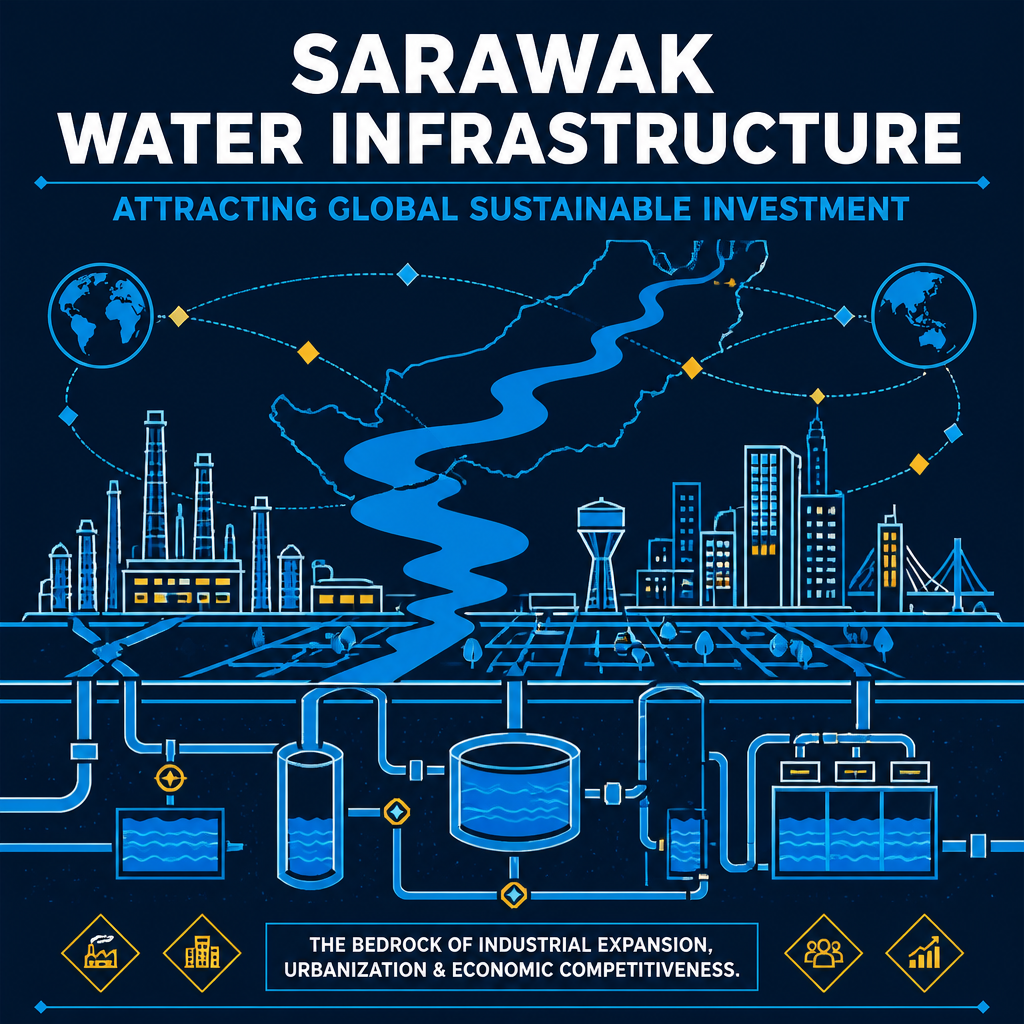
Water infrastructure is the primary economic enabler in Sarawak’s strategic framework, forming the bedrock on which industrial expansion, urbanization, and overall economic competitiveness are built.
The state’s ambitious goal of achieving an RM282 billion GDP by 2030 necessitates a reliable, efficient, and sustainable water supply system capable of supporting burgeoning industries, expanding populations, and new developments.
This creates a vast and growing market for investment in water treatment, distribution networks, wastewater management, and advanced water resource technologies.
The demand is not merely for basic service provision but for sophisticated infrastructure that can underpin high-value sectors such as food and beverage processing, manufacturing, and emerging technology hubs, all of which are likely targets for FDI under the 13th Malaysia Plan.
The connection between water security and economic activity is direct and fundamental; without a resilient water infrastructure, the state’s economic transformation risks stalling.
The regional context further underscores the urgency and opportunity in this sector.
In neighbouring Johor, a new pricing structure for treated effluent water, effective from August 2025, marks a shift towards more formalized and cost-recovery-oriented water management.
This trend indicates a broader movement across Malaysia toward valuing water resources more accurately and investing in their sustainable management, creating a favourable precedent for Sarawak.
The state’s proactive approach, evidenced by the passage of the Sustainable Resources and Wastes Management Bill 2025, positions it at the forefront of this regional transition.
This legislation provides a clear regulatory pathway for private sector investment, de-risking projects focused on waste-to-resource technologies, pollution control, and advanced water recycling.
For potential investors, this demonstrates a government that is not only aware of the challenges but is actively creating the institutional frameworks needed to attract capital and expertise.
Investment opportunities in Sarawak’s water sector are poised to attract significant flows of both FDI and DDI.
For foreign investors, the combination of rapid economic growth, a clear policy roadmap, and a supportive regulatory environment presents a prime opportunity to establish a foothold in a dynamic market.
International firms specializing in smart metering, leak detection systems, membrane filtration technologies, and large-scale desalination plants can leverage their expertise to meet Sarawak’s specific needs.
Simultaneously, the scale of the required infrastructure overhaul creates fertile ground for domestic investment.
Government procurement policies aimed at strengthening local capacity and partnerships will open up avenues for local Sarawakian companies in project management, civil engineering, logistics, and specialized maintenance services.
The government’s focus on cultivating economic opportunities in rural areas further opens niche markets for decentralized water purification systems and small-scale irrigation solutions, allowing local entrepreneurs to address community-specific needs.
This dual-track approach ensures that the benefits of infrastructure development are widely shared, fostering a resilient and self-sufficient domestic industrial base.
Powering Progress Towards a Sustainable Future
Energy constitutes the second co-foundational pillar of Sarawak’s investment landscape, serving as the indispensable fuel for its economic ambitions.
The state’s trajectory towards a high-income status, as outlined in the 13th Malaysia Plan, is entirely dependent on a power supply that is not only abundant and reliable but also scalable and increasingly green.
The Premier’s vision includes priorities such as sustainable land and water management and climate resilience, which inherently point towards a sustainable energy transition.
This alignment with global decarbonization trends makes energy investments in Sarawak particularly attractive to a new class of investors who are guided by Environmental, Social, and Governance (ESG) principles and are seeking to deploy capital into low-carbon infrastructure.
The state’s rich endowment of renewable energy resources, including hydropower, solar, and biomass, provides a strong foundation for this transition.
Sarawak is strategically positioned to become a key node within the broader ASEAN Power Grid, an initiative actively supported by the Asian Development Bank (ADB) through a mix of financial and technical assistance.
This regional integration effort enhances the value proposition for large-scale energy projects, as it opens up possibilities for cross-border power trade and creates a larger, more liquid market for electricity.
For investors, this means that energy projects developed in Sarawak can have a wider impact and potentially higher returns due to greater market access.
The government’s commitment to climate resilience and circular economy practices further reinforces the need for a diversified and sustainable energy portfolio, moving beyond traditional fossil fuels to embrace cleaner alternatives.
This creates opportunities in utility-scale solar farms, wind energy projects, and the development of energy storage solutions that are crucial for integrating intermittent renewable sources into the grid.
Attracting investment into this critical sector is supported by tangible financial mechanisms and policy support.
A key instrument is the RM1 billion Sustainable Development Finance Fund available in Malaysia, which is accessible to fund infrastructure projects until the end of 2025.
This fund can act as a catalytic source of capital, helping to de-risk initial project phases and attract matching private sector investment, both domestic and foreign.
Furthermore, the World Bank’s ongoing engagement with Malaysia, which includes public expenditure reviews and evaluations of financial taxonomies, signals a concerted effort to improve fiscal transparency and create a more efficient allocation of resources towards sustainable development goals.
These governance enhancements are critical for building investor confidence, as they ensure that public funds are used effectively and that private investments are integrated into a coherent national strategy.
Together, these elements- the regional integration context, the push for sustainability, dedicated funding mechanisms, and improved governance- create a robust and compelling investment case for energy infrastructure in Sarawak.
Human Capital as the Catalyst: Building a Resilient and Inclusive Society
Human capital is the third and final co-foundational pillar of Sarawak’s development strategy, acting as the catalyst that transforms investments in water and energy into sustainable economic growth and social progress.
The Premier’s explicit commitment to bolstering human capital development alongside economic expansion underscores its central importance.
A highly skilled, healthy, and adaptable workforce is the ultimate asset for any modern economy, and the government’s strategy recognizes that infrastructure alone is insufficient to achieve its high-income aspirations.
The focus on human capital ensures that the benefits of development are broadly distributed and that the population is equipped to participate in and lead the state’s economic transformation.
This approach directly addresses concerns about inequality, which can act as a barrier to long-term stability and growth.
The investment opportunities in this pillar are multifaceted, spanning education, skills training, healthcare, and social infrastructure.
The government’s plan to cultivate economic opportunities in rural areas is a direct investment in human capital, as it prevents brain drain and empowers communities to contribute to the state’s prosperity from their own locations.
This requires targeted investments in rural education, vocational training centres, and digital connectivity.
The Kuching Smart City Masterplan, with its aim to improve public transport, also contributes to human capital by enhancing access to jobs, educational institutions, and healthcare facilities, thereby increasing productivity and quality of life.
For both FDI and DDI, this creates a range of opportunities.
Foreign companies establishing operations in Sarawak will require partnerships with local educational institutions to develop customized training programs, creating a market for corporate social responsibility initiatives and private-sector-led education ventures.
Domestic investors can capitalize on the growing demand for private schools, technical colleges, healthcare services, and social housing to support the expanding workforce.
Moreover, a focus on human capital development is intrinsically linked to the state’s ability to attract and retain top-tier FDI.
Multinational corporations are increasingly evaluating potential locations based not just on cost and infrastructure but on the availability of skilled labour and the quality of the local living environment.
By investing in human capital, Sarawak enhances its attractiveness as a global business hub.
This creates a virtuous cycle.
FDI brings capital and technology, which boosts the economy and tax revenues, allowing the government to reinvest in education and healthcare, which in turn produces a better-skilled workforce that attracts more advanced forms of FDI.
This strategy also fosters social license for large-scale industrial projects by ensuring that local communities benefit directly through employment and improved public services.
Ultimately, human capital is the invisible infrastructure that gives tangible assets like water pipes and power lines their true value, transforming them into engines of sustained, equitable growth.
Aligning Investments with SDG 6 and its Core ESG Dimensions
The entire investment framework for Sarawak, centered on water infrastructure, energy, and human capital, is meticulously aligned with Sustainable Development Goal 6 (SDG 6): Clean Water and Sanitation.
This alignment is not merely a matter of corporate social responsibility but a core component of the state’s economic strategy, designed to attract investment from a global pool of capital that is increasingly guided by Environmental, Social, and Governance (ESG) criteria.
The global imperative for action is stark, with current trends indicating that the world will not achieve sustainable water management until at least 2049, a timeline that necessitates the mobilization of comprehensive financing and innovative approaches.
By positioning its development agenda squarely within the SDG 6 framework, Sarawak frames its investment opportunities as direct contributions to solving a critical global challenge, a narrative that resonates strongly with impact investors and institutions with strict ESG mandates.
The Environmental (E) dimension of SDG 6 focuses on improving water quality by reducing pollution, eliminating dumping, and treating hazardous chemicals.
Sarawak’s proactive legislative action, particularly the passage of the Sustainable Resources and Wastes Management Bill 2025, is a direct response to this challenge.
This bill provides a clear regulatory signal that investments in advanced wastewater treatment, industrial effluent management, and pollution control technologies are not only welcomed but are part of the state’s long-term vision.
For investors, this represents a significant de-risking factor, as it ensures a stable and predictable operating environment governed by clear environmental standards.
Every dollar invested in upgrading water treatment facilities or developing circular economy models that reuse treated water contributes directly to achieving SDG 6.1 (safe drinking water) and SDG 6.2 (sanitation).
The Social (S) dimension of SDG 6 is concerned with ensuring universal and equitable access to safe and affordable drinking water and sanitation for all.
Premier Zohari’s emphasis on cultivating economic opportunities in rural areas and pursuing inclusive growth strategies directly addresses this social imperative.
This focus ensures that infrastructure development is not confined to urban centres but extends to underserved communities, promoting equity and social cohesion.
From an investor’s perspective, projects that improve access to clean water in rural villages or provide sanitation facilities in low-income urban settlements offer measurable social impact metrics.
These outcomes are highly valued by impact investors and can be leveraged to secure blended finance instruments or concessional funding.
The connection between improved sanitation and better public health, a recognized outcome of SDG 6 achievement, further strengthens the social case for investment by contributing to a healthier and more productive workforce.
Finally, the Governance (G) dimension of SDG 6 involves implementing integrated water resources management, improving water efficiency, and ensuring stakeholder participation in decision-making processes.
Sarawak is actively strengthening its governance framework through collaboration with institutions like the World Bank, which is supporting public expenditure reviews and the timely publication of Environmental and Social (TES) frameworks by 2026.
These efforts promote transparency, accountability, and the efficient use of public funds, which are cornerstones of good governance.
For private investors, a strong governance environment reduces political and regulatory risks, making long-term infrastructure projects more viable.
By adhering to internationally recognized TES frameworks, Sarawak ensures that its development projects meet global standards for environmental protection and social safeguards, facilitating access to international financing and enhancing the reputation of all stakeholders involved.
This tight coupling of the state’s investment opportunities with the specific ESG dimensions of SDG 6 provides a powerful and verifiable narrative for discerning investors.
Synthesizing the Opportunity
In synthesizing the strategic landscape, a clear and compelling investment opportunity emerges for both Foreign Direct Investment (FDI) and Domestic Direct Investment (DDI) in Sarawak.
The state’s development model, anchored in Premier Datuk Patinggi Tan Sri (Dr) Abang Haji Abdul Rahman Zohari bin Tun Datuk Abang Haji Openg’s vision for a high-income, developed Sarawak, offers a rare convergence of ambitious growth targets, proactive government policy, and a firm commitment to sustainable and inclusive development.
The reframed narrative, built upon the three co-foundational pillars of water infrastructure, energy, and human capital, and tightly coupled to the imperatives of SDG 6, provides a robust and persuasive framework for investors worldwide.
This is not merely an invitation to invest in a promising market; it is an opportunity to be a partner in shaping a future defined by economic dynamism, environmental responsibility, and social equity.
For foreign investors, Sarawak presents a strategic gateway to a rapidly growing and modernizing region of Southeast Asia.
The demand created by the 2030 GDP target of RM282 billion will drive massive investment in water and energy infrastructure.
International firms can bring world-class technology, proven operational expertise, and significant capital to projects ranging from large-scale renewable energy farms and advanced water treatment plants to smart city solutions and sustainable industrial parks.
The proactive legislative environment, such as the Sustainable Resources and Wastes Management Bill 2025, coupled with the state’s alignment with regional initiatives like the ASEAN Power Grid, mitigates many of the risks traditionally associated with emerging markets.
Furthermore, the explicit linkage of these investments to SDG 6 and its core ESG dimensions allows foreign entities to make tangible, verifiable contributions to global sustainability goals, meeting stringent internal compliance requirements and reporting standards while simultaneously gaining a competitive edge in the global marketplace.
Simultaneously, a vast array of opportunities awaits domestic investors.
The government’s focus on strengthening local capacity and cultivating economic opportunities in rural areas is a direct call for DDI.
Local companies are perfectly positioned to participate in the construction, operation, and maintenance of the state’s new infrastructure.
This includes everything from civil works and engineering consultancy to logistics, IT support, and specialized services.
The existence of an RM1 billion Sustainable Development Finance Fund until 2025 provides a crucial source of domestic capital to seed these projects, reduce risk, and build a pipeline of bankable proposals.
By fostering a strong domestic industrial base, Sarawak ensures that the wealth generated from these investments remains within the state, creating a multiplier effect that supports local employment and entrepreneurship.
This dual approach, leveraging FDI for technology and capital while empowering DDI for local capacity and ownership, is the key to building a resilient and self-sustaining economy.
Ultimately, the success of Sarawak’s vision hinges on the synergistic relationship between these two streams of investment.
FDI brings the scale and sophistication needed to tackle complex infrastructure challenges, while DDI ensures deep community roots, local knowledge, and widespread socio-economic benefits.
Both are essential components of a strategy that is not only economically sound but also socially just and environmentally prudent.
The forward-looking data points, from the 2025 budget setting the stage for the next phase of development to the 2030 GDP target serving as the ultimate measure of success, provide an unambiguous roadmap.
For investors willing to look beyond short-term returns and embrace a long-term partnership, Sarawak offers a unique and compelling proposition: the chance to invest in a nation’s future while contributing to a more sustainable and equitable world.
References
Ahmad Zahid Hamidi. (2026, April 14). Rural water supply projects worth RM3.4 billion handed over to Sarawak to expedite implementation. Bernama. https://www.bernama.com/tv/news.php?id=2544700
Asian Development Bank. (2025). ASEAN Power Grid: Regional integration for sustainable energy. https://www.adb.org/sectors/energy/asean-power-grid
Borneo Post. (2026, April 14). Sarawak takes over 80 rural water projects from federal govt. The Borneo Post. https://www.theborneopost.com/2026/04/14/sarawak-takes-over-80-rural-water-projects-from-federal-govt/
Hydropower Sustainability Alliance. (2025, September 3). Bakun Hydroelectric Plant awarded Silver HSS certification. https://www.hs-alliance.org/news/bakun-hydroelectric-plant-silver-hss-certification
Julaihi Narawi. (2025, May 26). Rural water supply coverage at 70.5 pct, 99 pct in urban areas. The Borneo Post. https://www.theborneopost.com/2025/05/26/julaihi-rural-water-supply-coverage-at-70-5-pct-99-pct-in-urban-areas/
Malay Mail. (2025, August 26). Abang Johari: RM10b set aside for Sarawak water grid, treatment plants statewide, with aim of full coverage by 2030. Malay Mail. https://www.malaymail.com/news/malaysia/2025/08/26/abang-johari-rm10b-set-aside-for-sarawak-water-grid-treatment-plants-statewide-with-aim-of-full-coverage-by-2030/188994
Ministry of Utility and Telecommunication Sarawak. (2025, July 31). Julaihi: Sarawak to press on with master plan for 100 pct water coverage by 2030. https://mut.sarawak.gov.my/web/subpage/news_view/746
Ministry of Utility and Telecommunication Sarawak. (2025, August 27). Sarawak Water Sdn Bhd launched, merging KWB, SWB and LAKU into single state entity. https://mut.sarawak.gov.my/web/subpage/news_view/749
United Nations. (2025). Sustainable Development Goal 6: Clean water and sanitation. United Nations Malaysia. https://malaysia.un.org/en/sdgs/6
World Bank. (2025). Malaysia public expenditure review: Strengthening fiscal frameworks for sustainable development. https://www.worldbank.org/en/country/malaysia