
Project Samalaju Industrial Park (SIP) anchors Sarawak’s renewable energy-powered SCORE corridor, positioning it as a vanguard for green industrial transition.
Leveraging clean energy, SIP pursues industrial symbiosis by processing regional waste streams into resources, while attracting RM51.6 billion in investments to drive economic growth.
Its ambitions align tightly with state frameworks like PCDS 2030, Sustainability Blueprint 2030, and the 2050 Waste Management Master Plan, making it a testbed for advanced waste-to-energy and resource recovery.
However, a critical gap exists: publicly available quantitative data on current environmental performance (e.g., diversion rates, GHG reductions) is absent.
Thus, SIP’s sustainability achievements remain aspirational.
As a leading indicator for Sarawak’s long-term goals, its success depends on translating vision into verifiable outcomes, navigating high costs and logistical hurdles to deliver a replicable model for ASEAN.
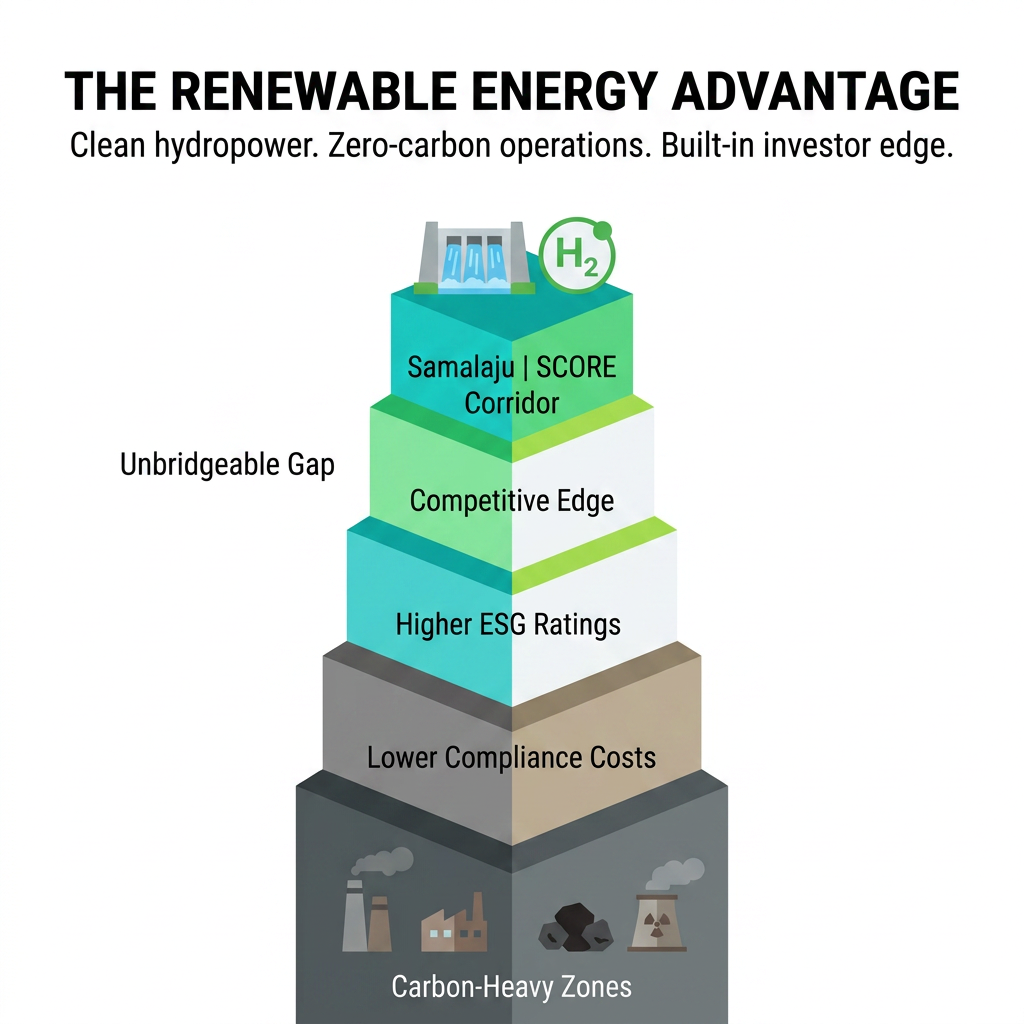
The Renewable Energy Advantage
Samalaju’s circular economy model rests on a non-negotiable foundation: abundant, renewable electricity from the SCORE corridor.
This clean power makes energy‑intensive processes, such as green hydrogen production, advanced waste treatment, and waste‑to‑energy, economically viable and environmentally superior.
Unlike industrial parks reliant on fossil‑fuel grids, Samalaju offers investors a low‑carbon operational footprint from day one, directly aligning with global decarbonisation mandates.
For forward‑looking capital, this translates into reduced compliance costs, enhanced ESG ratings, and a durable competitive edge that older, carbon‑heavy zones cannot replicate.
Industrial Symbiosis and New Revenue Streams
The park is designed as a regional hub for processing municipal, industrial, and agricultural waste into valuable resources, including biofuels, biofertilisers, recyclable metals, and even sustainable aviation fuel.
This industrial symbiosis turns one industry’s output into another’s input, creating multiple revenue layers from a single waste stream.
Investors can participate across the value chain, from material recovery facilities and biogasification plants to waste‑to‑energy units.
With RM51.6 billion already committed in a single year, the pipeline signals strong demand.
Early entrants can secure long‑term offtake agreements and capture margins from both waste processing and the sale of recovered products.
Policy Backing and Risk Mitigation
Sarawak’s state‑level frameworks, including PCDS 2030, the Sustainability Blueprint 2030, and the 2050 Waste Management Master Plan, provide clear, long‑term policy certainty.
The state has also assumed greater environmental autonomy, enabling targeted legislation like the Sustainable Resources and Wastes Management Bill 2025.
This reduces regulatory unpredictability for investors.
Furthermore, the government supports circular projects through guaranteed Power Purchase Agreements and stable tipping fees, mitigating revenue risk.
Samalaju is not an isolated venture; it is a coordinated flagship that benefits from top‑down political will, making it a safer bet than fragmented regional initiatives.
First‑Mover Advantage and ASEAN Scalability
Samalaju is a vanguard; its circular infrastructure is being built ahead of the state’s general waste‑management trajectory.
This early‑mover status offers investors the chance to shape standards, secure prime concessions, and gain proprietary operational knowledge that can be exported to other ASEAN industrial parks.
The region faces a looming waste crisis, with global waste projected to reach 3.4 billion tonnes by 2050.
By proving its model, Samalaju can become a replicable blueprint for green industrial zones across Southeast Asia.
Investors who seize this opportunity now will not only capture high returns but also position themselves as pioneers in the region’s circular economy transformation.
References:
ASEAN+3 Macroeconomic Research Office. (2026). From resource-rich to future-ready: Sarawak’s investment and green industrial growth. https://amro-asia.org/wp-content/uploads/2026/05/Malaysia-ACR-2026-SI-2-Sarawak-Investment-and-Green-Industrial-Growth.pdf
The Borneo Post. (2025, January 2). Score secures RM123 bln in cumulative approved investments as of 2024, fuels job creation, infrastructure growth. https://www.theborneopost.com/2025/01/02/score-secures-rm123-bln-in-cumulative-approved-investments-as-of-2024-fuels-job-creation-infrastructure-growth/
The Borneo Post. (2025, November 25). Sarawak tables Bill to establish Sustainable Resources and Waste Management Authority. https://www.theborneopost.com/2025/11/25/sarawak-tables-bill-to-establish-sustainable-resources-and-waste-management-authority/
Circular Business Review. (2025, September 12). Sarawak targets circular economy gains with 2050 Waste Management Master Plan. https://www.circularbusinessreview.com/sarawak-targets-circular-economy-gains-with-2050-waste-management-master-plan/
Ministry of Energy and Environmental Sustainability, Sarawak. (2025). Sarawak 2030 Sustainability Blueprint. https://meesty.sarawak.gov.my/web/subpage/webpage_view/52
Sarawak Government. (2021). Post COVID-19 Development Strategy 2030 (PCDS 2030). https://psc.sarawak.gov.my/web/subpage/webpage_view/198
Unit Komunikasi dan Penerangan Sarawak. (2026, June 11). Four pilot projects introduced to drive Bintulu-Samalaju transformation into Asia’s green industrial hub. https://ukas.sarawak.gov.my/web/subpage/news_view/42407