
- Processing multiplies raw produce value, so processors capture a larger share of final retail price than primary producers.
- Capital required is moderate versus many manufacturing sectors, with relatively short payback when facilities operate near capacity.
- New food projects qualify for 100 per cent income tax exemption for 10 years; expansions get five years full exemption. Applications close 31 December 2030.
- Pioneer Status offers 70 per cent income tax exemption on statutory income for five years for promoted food processing and agriculture activities, administered by MIDA.
- Sarawak Agro Fund offers grants and concessional financing reported at 2.5 to 5.0 per cent, subject to SLDB guidelines; NextGen provides RM20 million in grants.
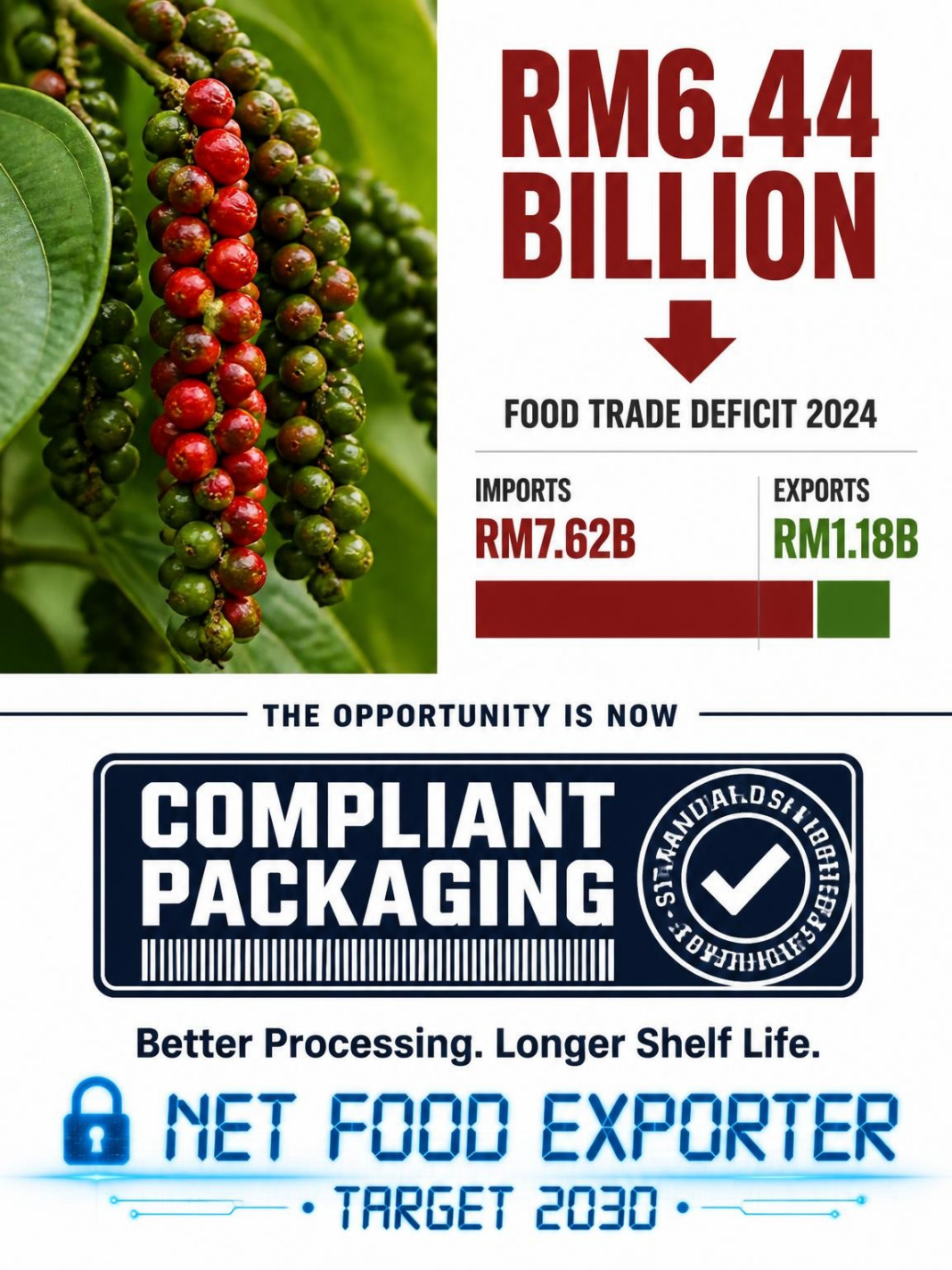
Sarawak recorded a food trade deficit of RM6.44 billion in 2024, with food imports reaching RM7.62 billion against exports of only RM1.18 billion. This gap shows that local producers still supply too little of the processed food that Sarawakians buy every day. Standardized processing, longer shelf life, and compliant packaging are practical ways to narrow that deficit. They allow local raw materials to be turned into products that can travel further and last longer. The state has set a target to become a net food exporter by 2030, and these three elements sit at the centre of that ambition. Without them, Sarawak will keep exporting low-value raw produce and importing high-value finished goods.
According to industry market research estimates, the global processed food market was valued at approximately USD6.52 trillion in 2025 and is projected to reach USD9.66 trillion by 2035, growing at around 4 per cent a year. Nearly 64 per cent of consumers worldwide depend on packaged or ready-to-eat products, and about 47 per cent prefer products with a longer shelf life. These numbers are not distant statistics. They describe the same convenience-driven demand that is growing in Malaysian cities and towns. Sarawak producers who meet this demand with safe, well-packaged products can compete for a share of a very large market. The opportunity is not limited to export; it also exists in replacing imported processed foods in local shops and supermarkets.
Processing turns perishable raw materials into stable products that can be stored, transported, and sold beyond the farm gate. Fresh vegetables, fruit, fish, and meat lose value quickly when they cannot be cooled or packed properly. Simple processing steps such as drying, freezing, retorting, or bottling reduce waste and allow farmers to sell surplus production instead of leaving it to rot. This is especially important in rural Sarawak, where transport to urban markets can take hours or even days. Processing also creates jobs in cleaning, cutting, cooking, packing, labelling, and distribution. Those jobs stay in the rural areas where the raw materials are produced.
Shelf life is the length of time a food product remains safe and good to eat under stated storage conditions. Without adequate shelf life, a product cannot be shipped to distant buyers, cannot sit on a supermarket shelf, and cannot be sold online with confidence. Technologies such as retort packaging, modified atmosphere packaging, vacuum sealing, and oxygen absorbers directly slow down spoilage and extend usable life. Specialized market research estimates the global shelf-life enhancement packaging segment alone at USD19.6 billion in 2025, with forecasts suggesting it could reach USD32.3 billion by 2032. Investing in shelf-life technology is therefore not a cost; it is a route to wider markets and lower waste.
Regulatory-compliant packaging is the bridge between a food producer and a legitimate retail market. Packaging must protect the food, carry accurate information, and meet food safety rules set by authorities such as the Malaysian Food Safety and Quality Division and, for halal products, JAKIM. Labels must show ingredients, allergens, net weight, storage instructions, and expiry dates in a clear and lawful way. Non-compliant packaging can cause products to be rejected by retailers, refused entry at borders, or recalled from shelves. Compliance also builds consumer trust, which is difficult to win back once lost. Good packaging is therefore both a legal necessity and a commercial asset.
Industry projections value the global packaged food market at USD5.88 trillion in 2024, expecting it to grow at about 5.7 per cent a year to reach USD10.3 trillion by 2034. Within this sector, chilled and frozen processed food alone stood at an estimated USD0.85 trillion in 2025 and is forecast to reach USD1.15 trillion by 2030. These figures reflect a steady shift toward foods that are convenient, safe, and reliably available. Sarawak producers who adopt proper processing, shelf-life control, and compliant packaging are positioning themselves inside a long-term global trend. Those who do not risk remaining confined to informal local markets with low margins and high waste.
Why these elements matter specifically in Sarawak
Sarawak’s geography makes processing and packaging more important than in Peninsular Malaysia. Many producing areas are far from major ports, cold-chain infrastructure is uneven, and rural roads can be slow or impassable during heavy rain. A product that spoils in transit destroys the farmer’s income and wastes the fuel and labour used to move it. Processing closer to the source, combined with packaging that protects the product, reduces these losses. It also allows producers to consolidate shipments and bargain for better transport rates. In a state the size of Sarawak, shelf life is not a luxury; it is basic market access.
Rural communities in Sarawak produce a wide range of high-potential raw materials, including sago, pepper, cocoa, coffee, Adan rice, pineapples, durians, and river fish. Most of these are currently sold raw or with minimal processing, which keeps prices low and profits in the hands of middlemen. Standardized processing allows communities to capture more of the final retail value. For example, sago starch exports reached RM63 million by August 2026, showing that processed or semi-processed Sarawak products can find external buyers. The same potential exists for coffee, fruit products, and traditional snacks if they are processed and packaged to consistent standards.
Food safety and halal compliance are particularly important in Sarawak’s diverse consumer market. A single incident of contamination can damage a small producer’s reputation permanently and can also harm the wider reputation of Sarawak food products. Standardized processing facilities with proper hygiene controls reduce this risk. Halal certification opens access to the large Muslim consumer market in Malaysia and abroad. Compliance with the Hazard Analysis and Critical Control Points system, Good Manufacturing Practice, and the Malaysian Food Safety Responsibility Industry scheme is increasingly demanded by modern retailers. Producers who meet these standards can supply supermarkets, hotels, and export markets that informal producers cannot reach.
The Sarawak government has made agriculture and food processing a central part of its development strategy. Agriculture contributed 10.54 per cent to the state’s GDP in 2022, amounting to RM14.6 billion. The Ministry of Food Industry, Commodity, and Regional Development has outlined a vision to achieve RM1 billion in export revenue from fisheries and aquaculture by 2030, with downstream processing as a key component. Public investment in collection, processing, and packaging centres reflects a deliberate policy choice to move the state up the value chain. Producers and investors who align with this policy direction can access government support that lowers their entry costs.
Sarawak still produces only about 32 per cent of its rice requirements and imports over 153,000 metric tonnes of rice each year. This dependence on imports illustrates a broader pattern: the state imports finished food while exporting raw or semi-processed commodities. Every step of local processing, from milling to retorting to packaging, keeps more value inside Sarawak. It also creates resilience against global supply disruptions and currency fluctuations. The goal of food self-sufficiency and the goal of food export growth are not in conflict; both depend on building a strong local processing base.
The facilities available: CPPC, PMMF, PPK, and CENTEXS
The Sarawak Department of Agriculture operates Collection, Processing, and Packaging Centres, known as CPPCs, as key enablers for addressing inefficiencies in distribution and marketing faced by farmers. Two CPPCs are already in operation or nearing operation, namely CPPC Tarat in Serian and CPPC Limbang, while four more are being implemented in Lawas, Sebangan, Lachau, and Long Lama. These centres are designed to collect produce from surrounding farms, process it into higher-value products, and package it for sale to wider markets. They reduce the need for each farmer to invest individually in equipment and premises. For rural communities, a CPPC is the most direct route from scattered smallholdings to a commercial supply chain.
The CPPC in Limbang, built at a cost of about RM5 million, is completed and focuses on local crops including honey pineapple, chilli, durian, and pineapple. The centre will provide centralized processing and marketing support so that farmers can move beyond selling raw fruit at farm-gate prices. It will also work with the Agriculture Department to train participating farmers and ensure a steady supply of raw materials. Similar centres in Lawas, Sebangan, Lachau, and Long Lama are at various stages of implementation. Each centre is tailored to the crops and conditions of its area, which makes them practical tools rather than one-size-fits-all solutions.
FAMA, the Federal Agricultural Marketing Authority, operates Food Processing Centres known as PMMFs, which offer contract manufacturing and packaging services to entrepreneurs who do not own a factory. These centres allow a small producer to manufacture products under their own brand without buying expensive machinery or renting a full production line. PMMFs also provide packaging and labelling services, and several have obtained ISO certification, Good Manufacturing Practice recognition, and halal certification for the products they handle. For a rural cooperative with a good recipe but no factory, a PMMF is a practical entry point into commercial production. It removes the largest capital barrier that keeps small producers out of the processed food market.
Area Farmers’ Organisations, known as PPKs, operate collection centres and marketing networks across Sarawak. As of October 2026, 86,854 farmers were registered with 28 PPKs throughout the state, and these organisations generated RM29.5 million in business volume through marketing, service, and production activities. At least 30 products have been commercialised under the unified Agripoint brand, with further product development and registration underway. The PPK network gives rural producers a ready-made organisational structure for aggregating supply, negotiating with buyers, and accessing government programmes. Cooperatives that work through their PPK can achieve scale that individual farmers cannot.
The CENTEXS Commercial Packaging Centre, or CCPC, is targeted to begin full operations in early 2027, with initial commercial packaging initiatives and partnerships already scheduled around January 2027, serving as a platform to help local entrepreneurs improve packaging quality and expand their businesses. It will provide packaging and food production facilities, along with support for product development, research and development, regulatory compliance, and halal awareness. The centre will initially work with five pioneer entrepreneurs and has partnered with agencies including MATRADE, DUBS, MARA, and SEDC. For micro and small entrepreneurs, the CCPC addresses a specific gap: the lack of access to commercial-grade packaging technology and the knowledge needed to meet retail standards. This is particularly valuable for products that require retort packaging for ambient storage or freezer packaging for frozen foods.
The CENTEXS packaging centre is designed to handle advanced packaging formats that many small producers cannot afford on their own. These include retort pouches, which allow food to be stored at room temperature for long periods, and freezer-grade packaging for chilled and frozen products. The centre’s operations head has noted that packaging is no longer merely about appearance but plays an important role in determining safety, shelf life, and competitiveness. By giving entrepreneurs access to these technologies on a shared-use basis, the centre lowers the cost of entering higher-value product categories. This is especially relevant for Sarawak producers of ready-to-eat meals, sauces, and traditional foods who want to supply modern retail outlets.
How rural communities and cooperatives can use these facilities
Rural cooperatives can use CPPCs as the first point of aggregation and primary processing for their members’ produce. Instead of each farmer arranging separate transport and processing, the cooperative can deliver to the nearest CPPC, where produce is cleaned, graded, and processed under controlled conditions. This reduces unit costs and improves consistency, which is essential for selling to larger buyers. The cooperative can then negotiate a supply agreement with a retailer or exporter on behalf of all its members. This model turns scattered smallholders into a reliable supplier group. It also gives the cooperative a physical base for quality control and record-keeping.
Cooperatives can access PMMF facilities through FAMA’s contract manufacturing arrangements, which allow them to produce packaged food under their own brand without owning a factory. The cooperative supplies the raw materials or the recipe, and the PMMF handles processing, quality control, and packaging according to agreed specifications. This arrangement is particularly suitable for products such as spice pastes, sauces, traditional snacks, and coconut-based products. It allows a cooperative to test the market before committing to large capital investments. If demand grows, the cooperative can then consider investing in its own facility with the experience and cash flow it has built.
The PPK network provides cooperatives with an existing marketing and distribution structure that reaches across Sarawak. PPKs operate retail shops, e-shops, and collection points, and they participate in state and national exhibitions such as Sarawak Agrofest and MAHA. A cooperative that produces a compliant packaged product can use these channels to reach customers without building its own sales force. The Agripoint brand, used across all 28 PPKs, provides a common identity that helps small producers gain shelf presence. Cooperatives should engage their local PPK early in the product development process to align packaging and pricing with what the market expects.
The CENTEXS CCPC can serve as a finishing school for cooperatives that have mastered basic production but need help with packaging and compliance. A cooperative can use the centre to test different packaging formats, improve label design, and learn about shelf-life testing and regulatory requirements. The centre’s partnerships with MATRADE and MARA also open doors to export advisory services and financing. This combination of technical support and market linkage is rare in rural settings. Cooperatives that use the centre strategically can shorten the time between a good product idea and a retail-ready product.
Collaboration between CPPCs, PMMFs, PPKs, and the CCPC can create a complete support chain rather than isolated facilities. A cooperative might collect and primary-process at a CPPC, manufacture and package at a PMMF or CCPC, and market through its PPK network. Each partner focuses on what it does best, and the cooperative moves its product through a series of specialised stages. This division of labour reduces duplication and allows each facility to operate at higher utilisation. It also gives rural producers a clear pathway from farm to market without needing to build every capability themselves.
The LINAWA cooperative in Lawas demonstrates how rural communities can take full ownership of a processed food brand when support is sustained. The cooperative now fully manages a brand built around Adan rice and Arabica coffee, after a five-year programme that provided training, mentoring, product innovation, and a processing facility for coffee collection, roasting, and packaging. Coffee cultivation in Long Sukang expanded from about 700 trees before 2021 to 7,230 trees, and the cooperative has 30 members. This example shows that cooperative ownership of processing and packaging is achievable when training and market access are combined. It also shows that the benefits extend beyond the cooperative to the wider farming community.
Collaboration and cluster development
The facilities should not compete with each other; they should form a coordinated system with clear roles. CPPCs are closest to the farm and should focus on collection, grading, and primary processing. PMMFs and the CCPC should focus on secondary processing, commercial packaging, and compliance testing. PPKs should focus on aggregation, marketing, and retail distribution. When these roles are clearly defined, a cooperative can move its product through the system without confusion or duplication. Coordination also allows the system to handle larger volumes and more complex products than any single facility could manage alone.
Shared standards across the system are essential for building buyer confidence. If a product is processed at a CPPC, packed at a PMMF, and sold through a PPK, the quality and labelling must be consistent at every stage. This requires common protocols for hygiene, record-keeping, and traceability. The agencies involved can support this by adopting shared standard operating procedures and providing training that is recognised across facilities. Consistency is what allows Sarawak products to be sold under a regional brand rather than as anonymous commodities.
The state’s agropark and permanent food production park initiatives can be linked to the processing and packaging network to create clusters. Agropark projects in Sarikei, Asajaya, Samarahan, and Betong are being developed to consolidate production and attract private sector participation. When these production areas are connected to nearby CPPCs and PPKs, the raw materials can move quickly into processing. This reduces transport costs and improves freshness. Clustering also makes it easier for extension officers and trainers to reach multiple producers at once.
Private sector participation is explicitly welcomed in Sarawak’s agricultural development strategy. The state has invited local and foreign firms to venture into commercial agriculture through privatisation, joint ventures, and partnerships with PPNS and PPKs. Processing and packaging facilities can be anchor points for these partnerships. A private firm can provide capital, technology, and market access, while cooperatives and PPKs provide land, labour, and local knowledge. This combination can unlock scale that neither party could achieve alone. The government’s role is to provide the enabling infrastructure and incentives that make such partnerships viable.
Investment returns and incentives
The processed food sector offers attractive returns because processing multiplies the value of raw agricultural produce. A kilogram of fresh fruit sold at the farm gate earns a modest price, but the same fruit processed into jam, juice, or dried snacks can earn several times more. The global demand figures show that this value multiplication is sustained by long-term consumer trends toward convenience and shelf-stable foods. For investors, the processing stage captures a larger share of the final retail price than primary production. The capital required is moderate compared with many other manufacturing sectors, and the payback period can be relatively short when facilities operate near capacity.
The Malaysian government has introduced a 100 per cent income tax exemption for 10 years for companies undertaking new food production projects, and a five-year full exemption for existing companies carrying out expansion projects. The application period has been extended to 31 December 2030. This is a direct fiscal incentive that improves the after-tax return on investment for food processing ventures. For a cooperative or small company considering a processing line, the exemption can free up cash for equipment, training, and market development. It signals that the government treats food production as a high-impact investment sector, comparable to electronics and green energy.
The Pioneer Status incentive provides a 70 per cent income tax exemption on statutory income for five years for companies engaged in promoted activities, including food processing and agriculture. This incentive is administered by the Malaysian Investment Development Authority and can be combined with other support measures depending on the project. Investors should assess whether their project qualifies for Pioneer Status or the newer food production tax exemption, as both can materially improve project economics. The key is to engage with MIDA and the Ministry of Agriculture and Food Security early in the planning process.
The Sarawak Agro Fund, or SAF, provides grants and concessional financing to agro-entrepreneurs, with interest rates generally reported to range from 2.5 per cent to 5.0 per cent (subject to the latest Sarawak Land Development Board guidelines). The fund includes instruments such as SAF1, SAF2, the SAF Corporate Fund, and the SAF Equity Fund, and it is managed through the Sarawak Land Development Board. For a rural cooperative, SAF financing can cover the cost of equipment, packaging development, or working capital. The below-market interest rates reduce the financial burden during the early, cash-intensive stages of a project. Cooperatives should work with their PPK and the SLDB to prepare a bankable proposal.
The Agropreneur NextGen programme under the Ministry of Agriculture and Food Security provides RM20 million in grants for start-up and expansion of agricultural projects. This programme is designed to bring younger entrepreneurs into agriculture and food processing. For a young cooperative member or a small company, the grant can cover part of the capital cost of a processing or packaging project. It can also support training and product development. Combining NextGen grants with SAF financing and the tax exemptions creates a layered support structure that reduces the equity required from the entrepreneur.
The Sarawak state government has allocated RM326 million to its food industry, commodity, and regional development ministry under the 2026 state budget, while the federal government has allocated RM158 million for Sarawak’s agricultural sector in the same year. These allocations fund infrastructure, extension services, and facility upgrades that support the processing and packaging network. For investors, this public spending reduces the cost of connecting to utilities, roads, and markets. It also signals sustained political commitment to the sector, which lowers policy risk. Public investment and private investment are complementary in this model.
Practical steps and risk management
Cooperatives and entrepreneurs should start with a clear product-market fit before investing in processing or packaging. The most successful products are often those that already have local demand and can be standardised without losing their traditional character. Market testing through PPK shops, e-shops, and local exhibitions can provide early feedback on packaging, pricing, and shelf-life performance. This reduces the risk of investing in equipment that does not match actual demand. Starting small and scaling up is more prudent than building a large facility before the market is proven.
Food safety and halal compliance should be built into the project from the beginning, not added later. Retrofitting a facility to meet Good Manufacturing Practice or halal requirements can be more expensive than designing it correctly from the start. The PMMFs and the CCPC can provide guidance on the standards that apply to different product categories. Cooperatives should budget for certification costs and the time required for audits. Compliance is not a one-off expense; it is an ongoing management commitment that protects the brand and the community’s reputation.
Packaging choice should be driven by the product’s storage and distribution needs, not by aesthetics alone. A product that will be sold frozen needs packaging that performs at low temperatures. A product that will sit on an ambient shelf needs a barrier against oxygen and moisture. A product that will be shipped long distances needs packaging that survives handling and stacking. The CCPC’s access to retort and freezer packaging technologies allows producers to choose the right format for their target market. Getting this decision right at the design stage avoids costly rework later.
Record-keeping and traceability are essential for selling to modern retailers and exporters. Buyers increasingly require evidence that food has been produced and handled safely at every stage. Simple systems for recording raw material sources, processing dates, batch numbers, and distribution can be implemented without expensive software. The PPK network and the processing centres can support cooperatives in adopting basic traceability practices. Traceability also helps in the event of a recall, limiting the damage to the brand and to public health.
Access to finance remains a challenge for many rural cooperatives, but the range of available instruments is wider than many realise. SAF loans, Agropreneur NextGen grants, and commercial bank financing backed by government guarantees can be combined depending on the project’s needs. The first step is to prepare a clear business plan with realistic revenue projections, cost estimates, and a timeline. PPKs and the processing centre operators can help cooperatives connect with the relevant financing agencies. A well-prepared proposal is more likely to secure support than a general request for funds.
Long-term vision and wider benefits
Building a processing and packaging ecosystem in Sarawak creates benefits that extend beyond individual businesses. It keeps more of the food value chain within the state, reducing the import bill and strengthening the local economy. It creates year-round employment in rural areas, which helps stem out-migration of young people. It improves food safety and availability for local consumers. And it builds skills in food technology, quality assurance, and marketing that can be applied to other sectors. These are public benefits that justify continued government investment in the network.
The target of becoming a net food exporter by 2030 is ambitious but not unrealistic if the processing and packaging gap is closed. Sarawak already exports sago, pepper, and other commodities, but most are sold with limited processing. Moving even a fraction of these exports into packaged, branded products would significantly increase export value. The global market for processed and packaged foods is large and growing. Sarawak does not need to capture a large share of it to achieve meaningful economic gains. It needs to capture a consistent, well-positioned share in specific product categories where it has a natural advantage.
The experience of the LINAWA cooperative shows that community ownership of a processed food brand is possible when the right support is in place. The cooperative moved from receiving external support to full ownership of a brand that sells rice and coffee with halal certification and award recognition. This model can be replicated in other districts with different products. The key ingredients are sustained training, access to processing facilities, and a reliable route to market. Cooperatives that commit to quality and consistency can build brands that outlast individual harvests.
Investors should view the processing and packaging sector as a long-term play rather than a quick return. The infrastructure is being built now, and the policy support is strong, but building a successful food brand takes time. Early movers can secure advantageous positions in supply chains, retail shelf space, and export relationships. The tax incentives and concessional financing reduce the cost of patience. Investors who combine capital with operational expertise and respect for local partnerships are likely to find the most durable opportunities.
The collaboration between agencies is a model that other regions could study. CPPCs provide the physical collection and primary processing infrastructure. PMMFs provide contract manufacturing and packaging expertise. PPKs provide organisation and market access. The CCPC provides advanced packaging and compliance support. No single agency can do everything, but together they cover the full chain. This integrated approach reduces duplication and makes better use of public resources. It also gives entrepreneurs a clear pathway rather than a maze of disconnected programmes.
Standardized food processing is not about erasing the traditional character of Sarawak food. It is about making that character safe, consistent, and accessible to more people. A traditional sago snack or a locally roasted coffee can retain its identity while being produced under modern hygiene standards and packed in materials that preserve its quality. Consumers increasingly value authenticity, but they also expect safety and convenience. The processing and packaging network allows producers to deliver both. This is how local food cultures can scale without losing their soul.
The environmental benefits of better processing and packaging should not be overlooked. Longer shelf life means less food waste, which reduces the resources wasted in production and transport. Efficient collection through CPPCs reduces the number of small, inefficient trips from farms to markets. Packaging choices can be optimised to use fewer materials while still protecting the product. These environmental gains align with growing consumer and regulatory expectations around sustainability. They also reduce operating costs over time.
The skills developed through the processing and packaging network are transferable and valuable. Workers learn food safety, quality control, machine operation, packaging technology, and inventory management. These skills can support other industries and make rural communities more resilient to changes in commodity prices. Young people who see a future in food processing are more likely to stay in their home districts. This helps maintain the social fabric of rural Sarawak while building a modern economy.
The role of the PPK as a trusted local institution should be strengthened alongside the physical facilities. PPKs already have the membership base, the retail outlets, and the relationships with farmers. They can act as the organisational backbone for cooperative processing ventures. With additional training and resources, PPKs can take on more responsibility for quality assurance, market intelligence, and supply coordination. Strong local institutions are essential for the long-term sustainability of the processing network.
The tax and financing incentives are generous, but they require entrepreneurs to plan and apply properly. Many small producers miss out on support because they are not aware of the programmes or because their proposals are incomplete. Cooperatives should seek assistance from PPKs, the Sarawak Land Development Board, and MIDA to understand which incentives apply to their projects. Early engagement with these agencies can save time and improve the chances of approval. The incentives are there to be used, but they are not automatic.
The market for halal processed food is a particularly strong opportunity for Sarawak producers. Malaysia is a global leader in halal certification, and Sarawak’s products can leverage this reputation in international markets. The PMMFs and the CCPC already provide halal awareness and compliance support. Cooperatives that obtain halal certification can access Muslim-majority markets in Indonesia, the Middle East, and beyond. This is a high-value niche where Sarawak has a credible advantage.
The combination of standardized processing, shelf-life extension, and regulatory-compliant packaging is the practical foundation for Sarawak’s food export ambitions. The facilities exist or are being built, the incentives are in place, and the global market is growing. What is needed now is for rural communities, cooperatives, and investors to use these assets in a coordinated way. The CPPC, PMMF, PPK, and CCPC network provides the infrastructure; the tax exemptions, SAF financing, and grants provide the capital; and the growing demand for safe, convenient, and authentic food provides the market. Sarawak’s food producers do not need to wait for a better opportunity. The opportunity is already here, and it is ready to be used.
References
Bernama. (2023, November 29). RM1b export earnings 2030 target set for Sarawak’s fisheries. Malay Mail. https://www.malaymail.com/news/malaysia/2023/11/29/minister-rm1b-export-earnings-2030-target-set-for-sarawaks-fisheries/104773
Bernama. (2024, November 11). Sarawak’s agriculture sector gets a boost with focus on food security. TV Sarawak. https://www.tvsarawak.my/2024/11/11/sarawaks-agriculture-sector-gets-a-boost-with-focus-on-food-security/
Bernama. (2025, May 10). Sarawak pushes for agricultural modernisation to become net food exporter by 2030. The Borneo Post. https://www.theborneopost.com/2025/05/10/sarawak-pushes-for-agricultural-modernisation-to-become-net-food-exporter-by-2030/
Bernama. (2025, October 10). Budget 2026: Gov’t allocates record support to padi farmers, RM20 million for Agropreneur NextGen programme. Bernama. https://www.bernama.com/en/general/news.php?id=2477175
Bernama. (2025, December 2). RM326 mln for Sarawak agri sector under 2026 state budget. Bernama Biz. https://www.bernamabiz.com/news.php?id=2498008
Future Market Insights. (2025). Food packaging market size, share & global trends 2035. https://www.marketresearchfuture.com/reports/food-packaging-market-2086
Grand View Research. (2025). Packaged food market size & share report, 2025–2033. https://www.grandviewresearch.com/industry-analysis/packaged-food-market
Rakan Sarawak. (2026). The road to 2030: Sarawak’s rise as a major food exporter. https://www.rakansarawak.com/the-road-to-2030-sarawaks-rise-as-a-major-food-exporter/
Sarawak Tribune. (2026, July 18). Highland cooperative takes full ownership of LINAWA. https://www.sarawaktribune.com/highland-cooperative-takes-full-ownership-of-linawa/
Sarawak Tribune. (2026, August). Sago starch exports reach RM63 million as of Aug 2026. https://www.sarawaktribune.com/sago-starch-exports-reach-rm63-million-as-of-aug-2026/
Sarawak Tribune. (2026, October). Sarawak farmers’ organisations generate RM29.5-million business volume. https://www.sarawaktribune.com/sarawak-farmers-organisations-generate-rm29-5-million-business-volume/
The Borneo Post. (2023, April 8). Limbang’s collection, processing and packaging centre ready for operation. https://www.theborneopost.com/2023/04/08/limbangs-collection-processing-and-packaging-centre-ready-for-operation/
The Star. (2025, October 11). Food industry to grow with 10-year tax exemption. https://www.thestar.com.my/news/nation/2025/10/11/food-industry-to-grow-with-10-year-tax-exemption