
Executive Synopsis:
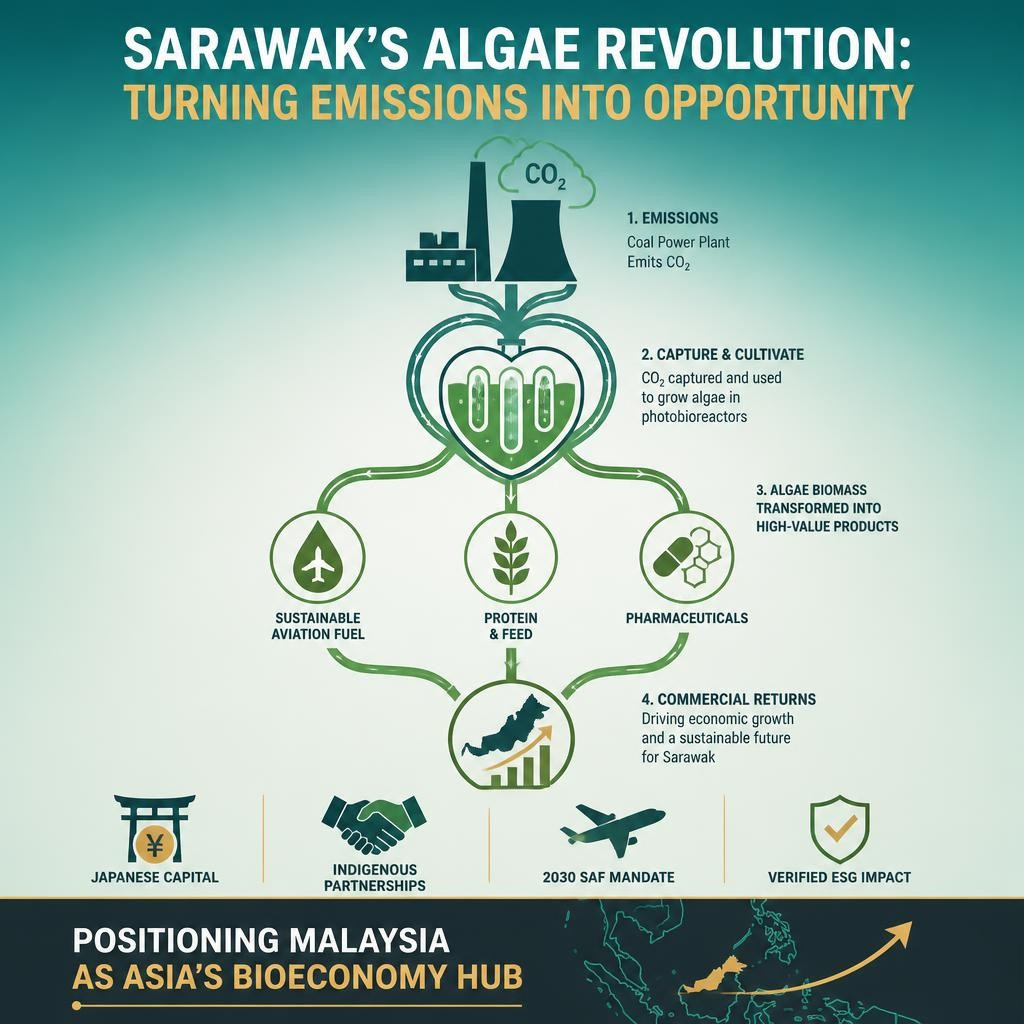
- World’s largest microalgae facility, capturing 200k tonnes CO₂ annually at full scale.
- Native strain bank and equatorial climate give Sarawak a defensible bio-advantage.
- Multi-output revenue: SAF, protein, nutraceuticals—RM2–3 billion yearly potential.
- Policy-guaranteed demand via 2027 global SAF blending mandates.
- Transparent ESG governance with indigenous benefit-sharing and rural job creation.
Full Article:
Sarawak’s Algae: High-Return ESG Engine for Asia
On the equatorial coastline of Sarawak, in the shadow of a coal-fired power station at Sejingkat, one of the world’s most consequential green-technology experiments is quietly scaling up. What began in 2012 as a research partnership between the Sarawak Biodiversity Centre (SBC) and Mitsubishi Corporation to study Borneo’s indigenous algae strains has evolved into the Chitose Carbon Capture Central Sarawak (C4 Sarawak) project, described by its Japanese developers as the largest industrial microalgae production facility in the world. For Malaysia, ASEAN, and Asia’s broader decarbonisation ambitions, Sarawak’s algae sector is emerging as a rare combination: a scientifically credible climate solution, a genuine job-creating industry, and a textbook Environmental, Social and Governance (ESG) investment thesis rolled into one.
The Science: Sarawak’s Unique Bio-Advantage
Sarawak’s case rests on a genuine biological edge. The state’s equatorial climate delivers consistent sunlight and high temperatures year-round, both essential for rapid algae photosynthesis, while abundant freshwater and freedom from typhoons and earthquakes make it an unusually stable location for long-term industrial cultivation. Crucially, SBC maintains a depository of some 600 native algae strains, a genetic reservoir that gives Sarawak a defensible scientific advantage other jurisdictions cannot easily replicate.
The C4 Sarawak facility’s design is itself an elegant piece of applied science: flue gas, the carbon-dioxide-laden exhaust from Sarawak Energy’s Sejingkat coal plant, is piped directly into bioreactors, where it becomes feedstock for algae growth rather than an atmospheric pollutant. This is a working circular-carbon-economy model, not a theoretical one. Government data released at the facility’s 2023 launch showed that a five-hectare pilot site can generate roughly 350 tonnes of algae biomass annually, yielding approximately 87 tonnes of extractable lipid, 192 tonnes of protein, and 52 tonnes of carbohydrate. That lipid fraction alone can be converted into about 45 tonnes of Sustainable Aviation Fuel (SAF). Scaled to the project’s stated 2,000-hectare commercial target, planned for 2030, preliminary estimates point to up to 140,000 tonnes of algae biomass produced annually, alongside roughly 200,000 tonnes of annual carbon dioxide abatement.
Beyond fuel, researchers at SBC have also flagged that several native microalgae strains show anti-cancer, anti-fungal, anti-bacterial and anti-inflammatory bioactivity, an indication that Sarawak’s biomass platform may eventually feed high-value pharmaceutical and nutraceutical pipelines, not just energy and feed markets. This multi-output structure- fuel, protein, pharmaceuticals, cosmetics, paints, and surfactants from a single, carbon-negative feedstock- is precisely what makes algae one of the most efficient bioeconomy platforms available today.
The Economics: A High-Potential, High-Return Proposition
The investment case is backed by figures that would catch the attention of any serious ESG-oriented allocator. Japan’s Chitose Group and its partners have already committed real capital: the Sejingkat facility received more than USD18.3 million in Japanese government funding (via the New Energy and Industrial Technology Development Organisation, NEDO, under Japan’s Ministry of Economy, Trade and Industry) as an initial vote of confidence in Sarawak’s model. Sarawak’s state government has projected that at full 2,000-hectare commercial scale, sales of the biomass’s lipid, protein and carbohydrate fractions alone could generate an estimated RM2 billion to RM3 billion (roughly USD430–645 million) in annual revenue, before accounting for carbon-credit monetisation, which at even a modest USD6.50 per tonne could add a further USD1.3 million a year in verified emissions-reduction revenue for a facility of that scale. Sarawak officials further estimate that a fully built-out 2,000-hectare operation could support up to 5,000 new jobs, many in rural and coastal communities that have historically had limited access to high-technology employment.
These state-level figures sit within a much larger global growth curve. Independent market analysts project the global microalgae market, spanning food, feed, nutraceutical and industrial applications, will expand from roughly USD0.78–0.84 billion in 2024–2025 toward well over USD1.5 billion by the early 2030s, while the broader algae biofuel market, valued at around USD9–10 billion in 2023–2024, is forecast to more than double to nearly USD13–20 billion by 2029–2032. Layered on top of this is a regulatory tailwind unique to aviation: global airline bodies are moving toward mandatory Sustainable Aviation Fuel blending requirements from 2027 onward, creating a structural, policy-guaranteed demand curve for exactly the product Sarawak is positioning itself to supply. In May 2024, InvestSarawak signed a memorandum of understanding with Japan’s Marubeni Corporation specifically to build a commercial-scale SAF value chain targeting both domestic and export markets by 2030, evidence that global trading houses are already underwriting this thesis with their own balance sheets.
For investors weighing ESG mandates against return expectations, this is the increasingly rare opportunity where the two are not in tension. The underlying asset, carbon-negative biomass grown on captured industrial emissions, is not an ESG overlay bolted onto a conventional business; it is the business model itself.
Impact on Malaysia: A National Bioeconomy Anchor
For Malaysia, Sarawak’s algae cluster is fast becoming a flagship proof point for the country’s broader green-industrial diversification away from fossil-fuel dependence. The Malaysian Investment Development Authority (MIDA) has actively profiled C4 Sarawak’s expansion as a national investment priority, positioning it alongside the state’s Post-COVID-19 Development Strategy (PCDS) 2030 and its Green Economy agenda. The project demonstrates to global capital that Malaysia, and specifically East Malaysia, can host frontier biotechnology at industrial scale, not merely as a low-cost manufacturing base but as a genuine research and innovation hub. It also gives Malaysia a credible, quantifiable decarbonisation story to bring to international climate finance discussions, converting an existing coal asset’s emissions into an input for a value-added green product rather than treating fossil generation and decarbonisation as mutually exclusive tracks.
Impact on ASEAN: A Regional Supply Hub
Sarawak’s geography places it within efficient shipping distance of Singapore, and within a wider logistics radius covering Japan, Taiwan, China, and the rest of maritime Southeast Asia, a point Chitose Group executives have explicitly cited as a reason for choosing Sarawak over other candidate sites. As ASEAN airlines and shipping lines face tightening international fuel-emissions rules, a domestically produced, regionally scaled SAF and biofuel supply chain reduces the bloc’s dependence on imported alternative fuels from Europe or North America. Sarawak’s ambition to export bio-jet fuel to neighbouring Southeast Asian nations, alongside the US and Europe, would additionally position ASEAN, for the first time in this sector, as a net exporter of advanced biofuel technology and feedstock rather than a downstream buyer, strengthening the region’s energy security and its negotiating position in global sustainability supply chains.
Impact on Asia: A Model for Circular, Cross-Border Green Industry
At the wider Asian level, the project is a case study in productive climate cooperation: Japanese capital, technology and government funding (via NEDO and METI) paired with Sarawak’s biological resources, land, and policy support, delivering a facility that Chitose Group itself has stated is intended to be replicated elsewhere once proven. Sarawak Premier, Datuk Patinggi Tan Sri (Dr) Abang Haji Abdul Rahman Zohari bin Tun Datuk Abang Haji Openg, is expected to present the initiative on the global stage at the World Economic Forum in Davos, underscoring how a subnational government is shaping a template for carbon-capture-linked bioeconomy development that other Asian jurisdictions, from Indonesia to Vietnam to South Korea, could adapt to their own industrial emissions sources.
Why ESG Investors Should Pay Attention
Every pillar of the ESG framework is visibly present and measurable here, not merely asserted. Environmentally, the project directly captures and reuses industrial CO2 while displacing fossil aviation and marine fuel demand. Socially, it channels new skilled employment into rural Sarawakian communities and, through SBC’s Benefit Sharing Agreements with indigenous groups such as the Iban communities documented in its bio-prospecting programmes, embeds indigenous knowledge-holders as genuine stakeholders and beneficiaries rather than bystanders. On governance, the project operates through transparent, multi-party consortium structures involving a state statutory body (SBC), a listed utility (Sarawak Energy), and an internationally accountable government funding agency (NEDO/METI), with SBC’s own organisational structure formally embedding ESG initiatives into its product-development mandate.
Funded Algae Platform Scales ASEAN
Sarawak’s algae sector is not a speculative green-technology bet; it is a functioning, funded, and scaling industrial platform with quantified biomass yields, identified revenue streams, policy-guaranteed future demand through 2027 SAF mandates, and a widening circle of international institutional partners. For Malaysia, it is a diversification anchor; for ASEAN, it is a path to fuel-supply sovereignty; for Asia, it is a replicable model of carbon-capture-linked bioeconomy cooperation. For ESG-minded capital seeking investments where environmental impact and commercial return genuinely reinforce one another rather than compete, Sarawak’s algae story deserves serious, immediate attention.
References
Bernama. (2023, May 10). Sarawak launches first microalgae production facility. https://bernama.com/en/news.php?id=2187784
Chiam, A. (2024, December 6). The algae revolution: Sarawak’s eco-innovative climate solution. DayakDaily. https://dayakdaily.com/the-algae-revolution-sarawaks-eco-innovative-climate-solution/
Fortune Business Insights. (2024). Microalgae market size, share, growth and global industry analysis by type & application, regional insights and forecast, 2024–2032. https://cn.gii.tw/report/fbs1891518-microalgae-market-size-share-growth-global.html
International Civil Aviation Organization. (n.d.). Carbon Offsetting and Reduction Scheme for International Aviation (CORSIA). https://www.icao.int/CORSIA
Marubeni Corporation. (2024, May 15). Commencement of a feasibility study for a biomass to SAF project in Malaysia. https://www.marubeni.com/en/news/2024/info/00027.html
Sarawak Biodiversity Centre. (n.d.). SBC’s natural product library. https://www.sbc.org.my/programmes/natural-product-library
Toh, C. S. (2024, February 6). Chitose to expand microalgae production facility by twentyfold. TVS. https://www.tvsarawak.my/2024/02/06/chitose-to-expand-microalgae-production-facility-by-twentyfold/