
The global economic landscape is undergoing a seismic shift, with the centre of gravity moving decisively toward the Indo-Pacific region.
Within this dynamic theatre, one jurisdiction stands out not merely as a participant but as a dominant architect of future prosperity.
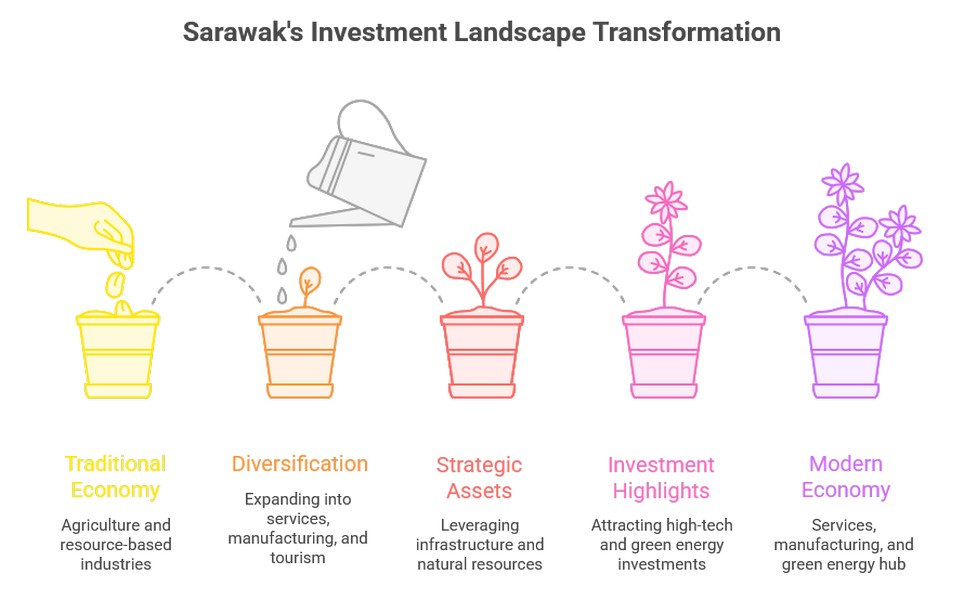
Sarawak, the largest state in Malaysia, has transcended its historical identity as a resource-rich hinterland to emerge as a sophisticated, autonomous economic powerhouse.
For the astute businessman and the visionary investor, Sarawak represents the ultimate investment destination, offering a convergence of political stability, abundant natural resources, and forward-looking policy frameworks that are unmatched in the region.
To overlook Sarawak today is to forfeit the ground-floor advantage of the next great economic boom, risking obsolescence in a world that is rapidly decarbonizing and digitizing.
The economic trajectory of Sarawak is defined by resilience and exceptional growth.
While many economies grapple with post-pandemic stagnation, Sarawak has consistently recorded Gross Domestic Product growth rates that outperform the national average of Malaysia and rival the fastest-growing nations in Southeast Asia.
Recent data indicate that Sarawak’s economy has expanded robustly, driven by a diversification strategy that moves beyond traditional commodities into high-value sectors.
The state’s commitment to the Post-COVID-19 Development Strategy 2030 serves as a master plan that guarantees long-term stability and predictable returns.
This strategy is not a mere document but a binding roadmap that aligns government expenditure, infrastructure development, and regulatory frameworks toward a singular goal of high-income status.
Investors entering this market are not betting on potential but are aligning themselves with a machine that is already in motion, fuelled by a compound annual growth rate that signals immense opportunity.
At the heart of Sarawak’s investment allure is its unparalleled energy advantage.
In a world desperate for clean energy solutions, Sarawak possesses one of the largest hydropower potentials in Southeast Asia.
This is not just about local consumption; it is about exporting the future.
The Sarawak Green Hydrogen Economy roadmap positions the state as a critical supplier of green fuel to energy-deficient nations in Asia and beyond.
By investing in Sarawak’s energy sector, businesses are directly contributing to the global net-zero agenda.
The cost of electricity in Sarawak remains competitive, providing a massive operational cost advantage for energy-intensive industries such as data centres, manufacturing, and green technology production.
This energy security is a shield against global volatility, ensuring that operations in Sarawak remain profitable even when global fuel prices spike.
Competitors who choose locations with unstable energy grids or high carbon taxes will find their margins eroding, while Sarawak-based entities will enjoy sustained competitiveness.
Beyond energy, the state offers a comprehensive suite of investment incentives designed to maximize capital efficiency.
Under the autonomy granted by the Malaysia Agreement 1963, Sarawak has the legislative power to tailor incentives that suit specific industry needs.
These include pioneer status tax exemptions, investment tax allowances, and exemptions from import duties on machinery and raw materials.
The Sarawak Investment Corporation acts as a one-stop centre, streamlining approvals and reducing bureaucratic red tape that often plagues other jurisdictions.
Furthermore, the Sarawak Digital Economy Corporation facilitates the Digital Trade Corridor, offering specific grants and tax breaks for technology companies.
These incentives are not temporary measures but structural components of the state’s economic policy.
For a multinational corporation, these fiscal benefits translate directly to the bottom line, improving return on investment timelines significantly compared to neighbouring regions where tax regimes are more rigid and less accommodating.
The strategic geography of Sarawak further cements its status as a global logistics and trade hub.
Situated on the island of Borneo, Sarawak commands the South China Sea trade routes, providing direct access to the massive markets of China, Indonesia, and the broader ASEAN region.
The Pan Borneo Highway project, a massive infrastructure undertaking, is integrating the state’s interior with coastal ports, reducing logistics costs, and opening new areas for development.
Ports such as Samalaju and Kuching are being expanded to handle increased cargo volumes, facilitating seamless export capabilities.
An investor in Sarawak is effectively planting a flag at the crossroads of Asian trade.
Ignoring this geographic advantage means accepting higher logistics costs and longer supply chain lead times, which in the modern just-in-time economy can be the difference between market leadership and irrelevance.
It is imperative to address the cost of inaction.
The window to enter Sarawak at the most favourable valuation is closing.
As more global players recognize the state’s potential, land prices, access to resources, and partnership opportunities will become increasingly scarce and expensive.
Investors who hesitate are essentially allowing competitors to secure the best locations, the most lucrative government contracts, and the strongest local partnerships.
In the race for green hydrogen and rare earth minerals, which Sarawak possesses in abundance, first-mover advantage is critical.
Those who delay will find themselves purchasing resources at a premium or being locked out of supply chains entirely.
Furthermore, as Sarawak’s economy matures, regulatory frameworks may tighten to prioritize local equity and environmental standards.
Entering now allows investors to shape these regulations through constructive engagement, whereas entering later means adapting to rules set by others.
The loss is not just financial; it is strategic.
It is the loss of influence, market share, and the opportunity to define an industry.
The impact of investing in Sarawak extends far beyond balance sheets; it resonates with global development goals.
Every ringgit invested in Sarawak’s sustainable industries contributes to the global supply of critical minerals needed for electric vehicles and renewable energy infrastructure.
The state’s timber industry, now strictly regulated and focused on downstream value-added products, sets a global benchmark for sustainable forestry.
By choosing Sarawak, investors align their portfolios with Environmental, Social, and Governance criteria that are increasingly mandated by global shareholders.
SARAWAK’S 12 ADMINISTRATIVE DIVISIONS: INVESTMENT LANDSCAPE BY REGION
| Division | Key Economic Sectors | Strategic Assets | Investment Highlights |
|---|---|---|---|
| Kuching | Services, Manufacturing, Tourism, Digital Economy | International Airport, Sama Jaya Free Industrial Zone, State Capital | Hub for high-tech manufacturing, ICT startups, and business servicesinvestsarawak.gov.my |
| Samarahan | Education, Agriculture, Light Manufacturing | Universities, Agroparks, Integrated Townships | Growing education hub with free STEM tertiary education from 2026investsarawak.gov.my |
| Serian | Agriculture, Agro-processing, Eco-tourism | Border proximity to West Kalimantan, fertile agricultural land | Cross-border trade potential; organic rice and pepper productionResearchGate |
| Sri Aman | Agriculture, Forestry, Renewable Energy | Batang Ai Hydro Dam, Floating Solar Project | First major hybrid hydro-solar facility; sustainable agriculture initiativesinvestsarawak.gov.my |
| Betong | Agriculture, Palm Oil, Timber Processing | Integrated Agroparks, Rural Infrastructure | Focus on commercial agriculture and downstream food processingdayakdaily.com |
| Sarikei | Agriculture (Pepper, Pineapple), Fisheries | Rajang River access, Port connectivity | Leading pepper producer; aquaculture development zonesen.wikipedia.org |
| Sibu | Shipbuilding, Timber, Food Processing, Manufacturing | Rajang River Port, Industrial Estates | Major shipbuilding hub; timber processing and F&B manufacturingwww.mida.gov.my |
| Mukah | Energy, Halal Industry, Aquaculture | Tanjung Manis Halal Hub, Deep Sea Port | SCORE growth node; integrated palm oil and halal food productionrecoda.gov.my |
| Kapit | Hydropower, Forestry, Eco-tourism | Baleh Dam (1,285 MW, commissioning 2026), Rainforest Access | Renewable energy backbone; nature-based tourism developmentrecoda.gov.my |
| Bintulu | Petrochemicals, LNG, Manufacturing, Green Hydrogen | Samalaju Industrial Park, LNG Complex, Deep Sea Port | RM51.6 billion in approved investments at Samalaju; green hydrogen production hubkerjasarawak.com |
| Miri | Oil & Gas, Tourism, Digital Economy, Aerospace | International Airport, Bio-Valley Park, Offshore Platforms | Traditional energy hub transitioning to renewables; MWC 2026 spotlightwww.facebook.com |
| Limbang & Lawas | Agriculture, Cross-border Trade, Mining | Brunei border access, Mineral resources | Strategic location for BIMP-EAGA trade; silica sand and rare earth explorationbernama.com |
Source: Sarawak Government Administrative Data sarawak.gov.my ; SCORE Investment Booklet recoda.gov.my
This alignment enhances brand reputation and opens doors to green financing that is unavailable for projects in less-regulated jurisdictions.
Therefore, business in Sarawak is not an isolated commercial activity but a contribution to global stability and environmental stewardship.
The ripple effect of a successful manufacturing plant in Samalaju or a data hub in Kuching is felt in the reduced carbon footprint of the global economy and the stabilization of regional trade networks.
Political stability in Sarawak is another cornerstone that de-risks investment.
The state government has demonstrated a long-term vision that transcends electoral cycles, providing a consistent policy environment.
This stability is rare in the developing world, where policy flip-flops can wipe out billions in value.
The leadership in Sarawak has cultivated strong diplomatic and trade ties with major economies, ensuring that external geopolitical tensions do not disrupt local business continuity.
For investors wary of regional volatility, Sarawak offers a safe harbour.
The social fabric of the state is equally robust, characterized by harmony among diverse ethnic groups, which ensures a stable workforce and minimizes the risk of labour unrest.
This social license to operate is a tangible asset that protects investments from disruption.
Comparative data further illuminates the superiority of the Sarawak proposition.
When juxtaposed with other emerging markets in the Mekong region or parts of Indonesia, Sarawak offers superior infrastructure reliability and higher ease-of-doing-business rankings.
The cost of setting up a factory in Sarawak, when adjusted for tax incentives and energy savings, is often lower than in Vietnam or Thailand, while the proximity to China offers a logistical edge over South Asian alternatives.
Moreover, the legal framework in Sarawak is based on English Common Law, providing familiarity and security for international investors that civil law jurisdictions may not offer.
The transparency in land titles and contract enforcement in Sarawak reduces the legal risks that often deter foreign direct investment in neighbouring territories.
These comparative advantages are not marginal; they are fundamental drivers of profitability that compound over the lifespan of an investment.
The narrative of Sarawak is one of inevitable ascent.
The convergence of cheap green energy, strategic location, fiscal incentives, and political stability creates a perfect storm for wealth creation.
To treat Sarawak as merely another option in a portfolio is to misunderstand the magnitude of the opportunity.
This is a jurisdiction that is actively rewriting the rules of economic development in the tropics.
The government is not a regulator to be managed but a partner eager to facilitate success.
The infrastructure is not a promise but a reality under construction.
The resources are not theoretical but proven and ready for extraction and processing.
In conclusion, the decision to invest in Sarawak is a decision to secure a future-proof position in the global economy.
The data supports the confidence, the incentives support the profitability, and the strategic vision supports the longevity of any venture established within its borders.
Conversely, the decision to wait is a decision to accept higher costs, reduced market access, and diminished influence.
The global economy is moving toward sustainability and digitalization, and Sarawak is the engine room for this transition in Southeast Asia.
Businessmen and investors who fail to capitalize on this moment will look back with regret as they watch their competitors reap the rewards of a market that has matured beyond their reach.
Sarawak is open, ready, and waiting for partners who possess the vision to see what others miss.
The time to act is now, for the cost of waiting is a price no savvy investor can afford to pay.
The future of global development is being forged in Sarawak, and the question remains whether you will be part of its creation or merely an observer of its success.
References
Department of Statistics Malaysia. (2023). Gross domestic product by state 2022. DOSM.
Sarawak Government. (2021). Post-COVID-19 Development Strategy 2030. Sarawak Economic Development Corporation.
World Bank. (2022). Malaysia economic monitor: Investing for a low carbon future. World Bank Group.
Sarawak Investment Corporation. (2023). Invest Sarawak: Incentives and opportunities. SIC.
Ministry of Economy Malaysia. (2023). Mid-term review of the twelfth Malaysia plan. Prime Minister’s Department.